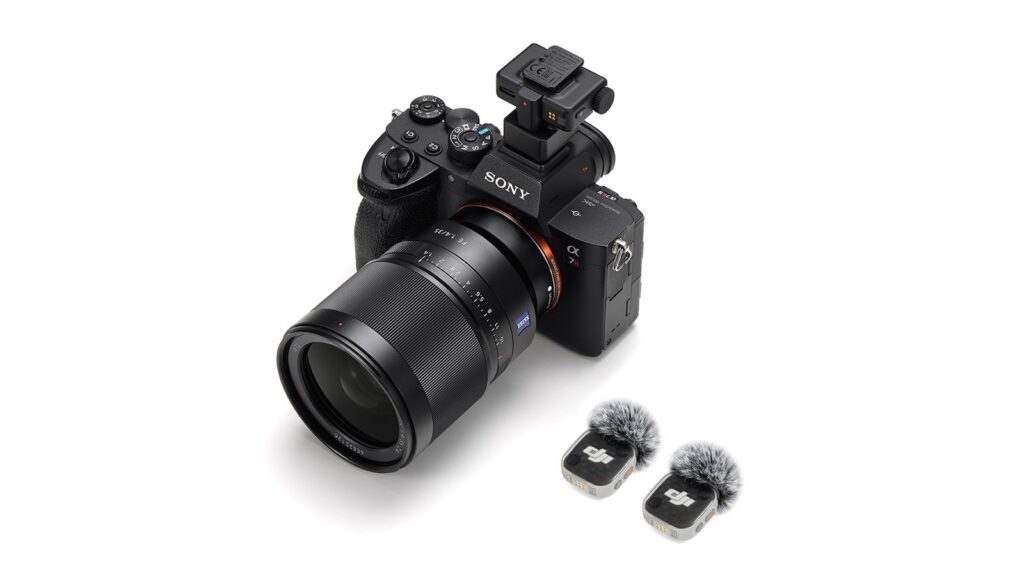
DJI put the Mic Mini 2S on sale today, and for once the headline isn’t the price. It’s something small wireless mics simply didn’t do: record on board. Each 12-gram transmitter carries 14.5GB of internal storage, good for roughly 28 hours at 24-bit or about 22 hours in 32-bit float. In plain terms, if the link to the receiver drops, the track keeps existing on the transmitter.
Anyone shooting documentaries or interviews knows why that matters. A wireless dropout never announces itself in your headphones at the right moment — you find it in the edit. Having a local copy that nobody has to remember to start is the difference between a hole you patch and a hole that isn’t there.
What’s actually in it
- One receiver handles up to four transmitters (the Mic Mini 2 stopped at two), with Mono, Safety Track, Stereo and Quadraphonic output: four separate tracks to sort out in post.
- Cross-generation compatibility: the new receiver accepts Mic Mini, Mic Mini 2 and 2S transmitters in any mix, at 48kHz 24-bit, with a stated range of up to 400 metres.
- File offload from the charging case at up to 34MB/s — DJI says 30 minutes of 24-bit audio moves across in about eight seconds.
- NPU-based AI noise cancelling at two levels, plus Clipping Control and Loudness Balance for uneven speakers.
- Runtime: around 11 hours for the transmitter, 10 for the receiver, roughly 40 hours in total with the case.
That last figure deserves an honest note: the Mic Mini 2 quoted 11.5 and 10.5 hours, and crucially 48 hours total with the case. Eight hours less in reserve means nothing on a city shoot; it means quite a lot on a week of filming up in the mountains, where the nearest outlet is wherever you parked the van.
Why we actually care
In our view the point isn’t the price — 99 euro for the 1 TX + 1 RX kit, 189 euro for the two-transmitter kit with case — but the fact that audio redundancy stops being a luxury reserved for the sound mixer’s bag. On the ground, the average production we work with is a two or three person crew: an operator, a director who also runs the interview, maybe an assistant. In that setup nobody watches levels continuously, and a backup that records itself is worth more than ten menu items.
That said, we’re not buying the story that this replaces a sound recordist. It’s still 2.4GHz: in a crowded old town, at a trade fair or inside a Wi-Fi-saturated warehouse it behaves like every other system in its class. And four separate tracks are not a mix — someone in post has to line them up and balance them. If the project is dialogue-heavy fiction, the boom operator with their pole and their recorder is still needed, and anyone saying otherwise has never had to rescue a scene in ADR.
How we’d use it on set
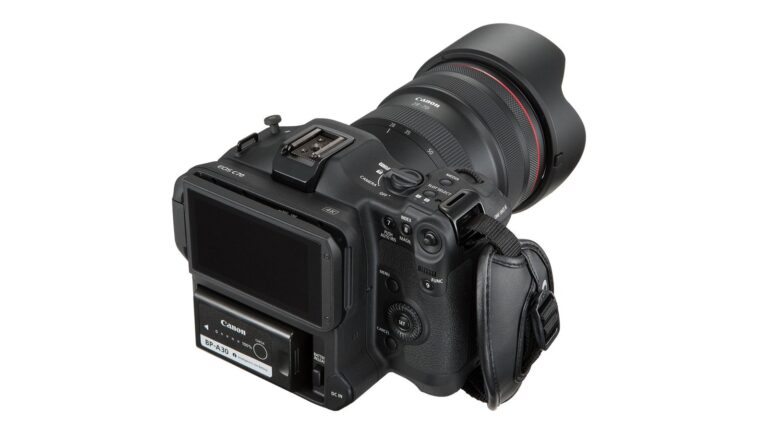
The combination that makes most sense for the work we see here in Abruzzo is obvious and it works: clean audio into the camera, transmitters as the safety net. On a documentary with the Sony FX6 or the Canon EOS C70 you already have two decent XLR channels; the 2S gives you the internal copy that saves you when the subject walks off or turns away. In a light configuration — a Sony FX3 on the shoulder for backstage or a music video — it simply becomes the primary system.
One practical note that applies to every mini system: the rear clip is detachable and rotatable, so take thirty seconds to aim the capsule before you roll. A transmitter mounted upside down under a jacket produces audio that no noise cancelling will fix.
The Mic Mini 2S is available now from DJI and authorised dealers. We don’t rent it — wireless audio stays outside our catalogue — but if you’re putting together a documentary kit and you want the sound department to stop being the weak point of the day, this is the most interesting release of the year in its bracket.
Official source: DJI Mic Mini 2S product page. Verification and specs: CineD.
A wide range of equipment in our catalogue, on-set delivery included across Abruzzo.