It happens on Abruzzo sets more often than people expect: you gain altitude, drive into a valley inside the National Park or reach a village in the inland areas, and 4G is gone. Missing a text message is fine, but the moment production has to send dailies, jump on a call with the client or download a signed release, connectivity becomes a department just like lighting or sound. That is why we keep the Starlink satellite internet kit in our rental inventory: in our experience it saves more shooting days than its price suggests.
What actually shows up on location
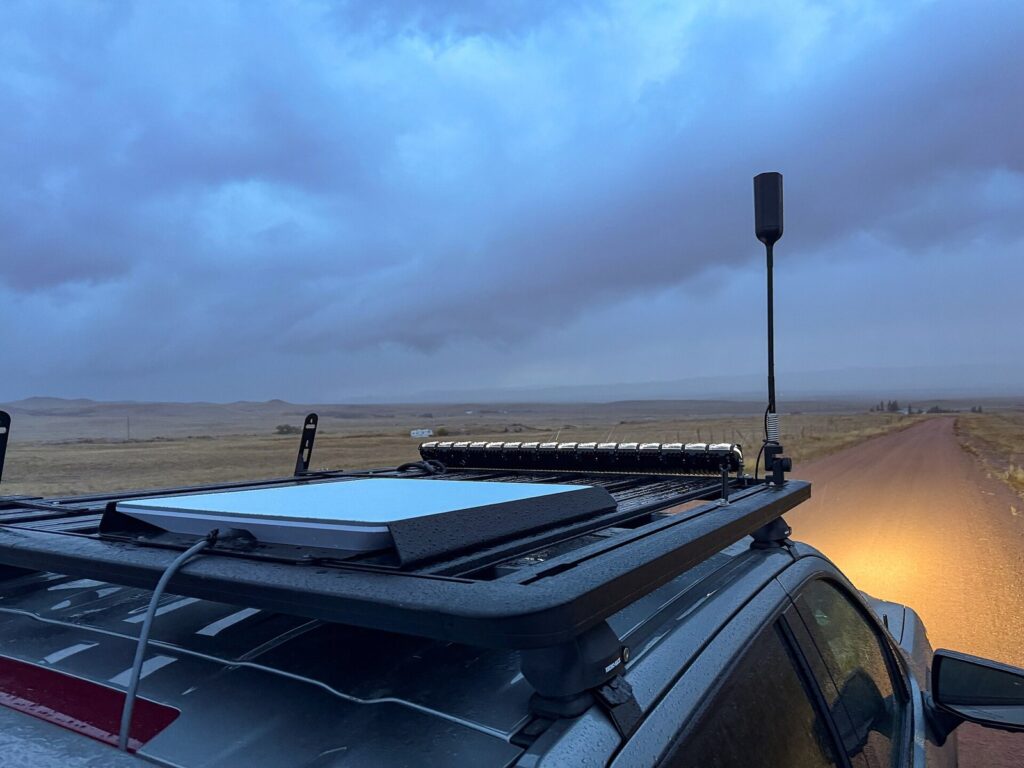
The kit is deliberately simple: a self-aligning dish and a Wi-Fi router. You place it with a clear view of the sky — a car park, the roof of the van, an open field with nothing overhead — power it from 230 V (the generator you already have on the truck works fine) and the crew is online in minutes. No SIM cards, no configuration, no calls to a network provider. Service specs are published on the official Starlink website.
- Low Earth orbit (LEO) satellite connection
- Typical downloads in the 50-200+ Mbps range
- Typical latency of 25-60 ms
- Works where 4G and 5G simply do not reach
The figure that matters most is not peak speed, it is latency. At 25-60 ms a production call or a remote review session feels normal; with the old geostationary satellite services, sitting on half a second of delay, a real conversation was impossible.
When it genuinely pays off
On the ground we have seen three situations where the kit pays for itself on day one.
Documentary and reportage in the inland areas
Shooting docs in the mountains means coming back to base camp with full cards and no way to secure them before evening. With a real connection you start the cloud backup while the crew wraps, instead of sending someone down the valley to the first village with a signal. If you are running long days on a Sony FX9, that is the difference between sleeping well and not sleeping at all.
Productions with remote approval
Commercials and branded content where the agency or the client is not on set: sending a frame, a selects reel or a rough cut while you are still shooting avoids the round of second thoughts the following day, which is always the expensive one.
Heavy footage
If you record high-resolution RAW — think of a Blackmagic URSA Cine 12K — dailies do not fit on a thumb drive and transfers cannot be improvised. Having real bandwidth on location changes the pace of the entire post workflow.
Three practical lessons from the field
- A genuinely clear view of the sky. Branches, ledges and scaffolding above the dish cause micro-dropouts you will not notice until the video call starts. Ten extra metres of cable and a clean spot are always worth it.
- Dedicated power. Put it on the same generator as the lights and every HMI or COB striking up will make itself felt. Plan a separate line or a small UPS.
- Wi-Fi will not cover the whole set. There are often walls and fifty metres between the dish and video village: if the director needs to be online, run an ethernet cable instead of hoping for signal.
What we pair it with
In practice it goes out with the main camera body and a work station: a laptop for the DIT, drives for backup and, when the set is mobile, power distribution. In our ready-made kits we list it separately, because not every production needs it — but the ones working outside network coverage need it badly.
Why rent instead of buying
Buying the hardware and keeping a monthly subscription alive only makes sense if you work in dead zones every month. Most productions are talking about a handful of days a year: with us the kit is 75 € per day, 185 € for three days and 260 € per week (VAT excluded), with delivery and pickup on set included across the whole region. If a single day lost to an undelivered file costs more than that, the maths is already done.
A wide range of equipment in our catalogue, on-set delivery included across Abruzzo.