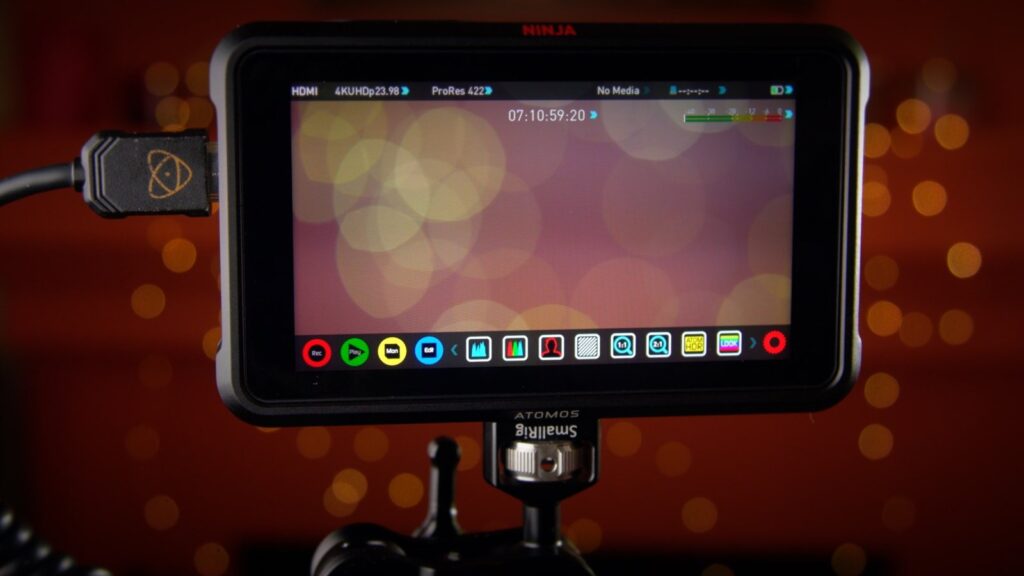
The Atomos Ninja V is eight years old by now — Atomos launched it at NAB 2018 for 695 dollars — and it still leaves our shelf more often than most of the newer kit. That is not nostalgia. In a 360-gram box it solves two problems at once: it lets you actually see your image in bright sun, and it takes the camera’s internal codec out of the equation.
What it does, briefly
A 5.2-inch touchscreen at 1000 nits. HDMI 2.0 in and out. It records up to 4K 60p in 10-bit 4:2:2 ProRes or DNxHR onto a 2.5-inch SSD, and in ProRes RAW when the camera pushes a raw signal down the HDMI line. Waveform, vectorscope, false colour, focus peaking and LUT loading are all on board — tools a mirrorless body simply does not have, and that on a small set are the difference between guessing your exposure and nailing it.
When it earns its place on the list
Three situations, in our experience.
- A clean master for grading. If the client wants proper colour work, recording ProRes 422 HQ instead of internal H.264 makes the colourist’s life far easier and skips transcoding before the edit. On a short film or a commercial, that time comes straight back to you in post.
- Exteriors in hard light. Abruzzo throws awkward conditions at you: August sun on the coast, snow at Campo Imperatore, valleys shot straight into the light. A camera screen will not cut it there; 1000 nits will.
- Documentary and reportage. The Ninja doubles as a second recorder: if the card in the camera fills up or misbehaves, you still have the copy on the SSD.
Three things that will save you a shooting day
Power is the weak point. It runs on NP-F batteries, and with the screen at full brightness one battery lasts roughly an hour. We always suggest taking three or four, or running off mains power when you are indoors: going dark halfway through a scene is a classic way to lose half an hour.
Lock down the HDMI cable. The connector on the Ninja is full-size and holds well, but the other end is usually a fragile micro-HDMI on a mirrorless body. A cage and a cable clamp are not a luxury: they are the difference between a good take and a reshoot because the signal dropped.
Do the maths on storage. With the 1 TB SSD we include you are looking at roughly two and a half hours of 4K ProRes. On a long event, either offload during the day or budget for a second drive.
What we pair it with
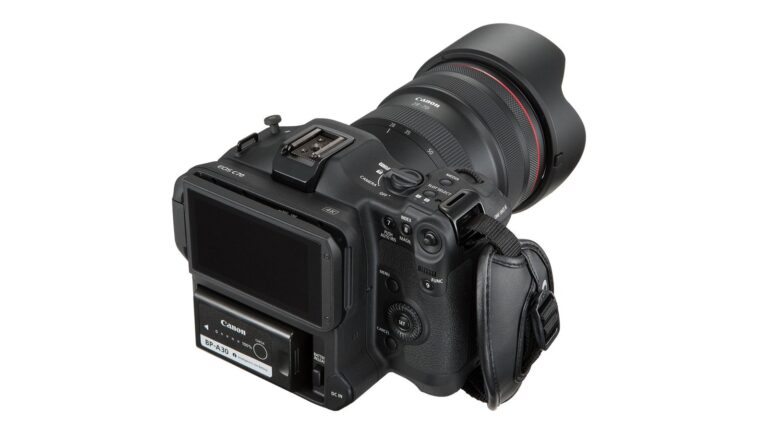
It gets along with almost anything, but the combinations that work best are the Sony FX3, which outputs raw over HDMI so you can record straight to ProRes RAW, and the Canon EOS C70 when you want a more production-oriented body that is still compact. On the Sony FX6, keep in mind that raw comes out of the SDI port: with the Ninja V you stop at 10-bit 4:2:2 over HDMI, which for the vast majority of jobs is plenty. One practical note if you work on a gimbal: the Ninja will mount on a DJI RS 3 Pro, but it adds weight and throws off the balance. Better to take the monitor off the camera and send the signal to video village with a Teradek Bolt 6 750.
Buy or rent
The maths here is blunt. With us the Ninja V is 20 euros a day, 50 euros for three days and 80 euros a week, with a 1 TB SSD included — and that last detail is what really counts, because certified drives cost about half as much as the monitor itself. If you shoot two or three times a year, renting is not even a discussion. If you would put it on every job, buying makes sense, but then it is worth looking at the current models too: the Ninja V is discontinued and the Atomos range has moved on. When in doubt, ask us: we would rather tell you that you do not need it than simply rent it to you. The rest of the inventory is under equipment and in our ready-made kits.
Sources: Atomos and Newsshooter’s field review.
A wide range of equipment in our catalogue, on-set delivery included across Abruzzo.