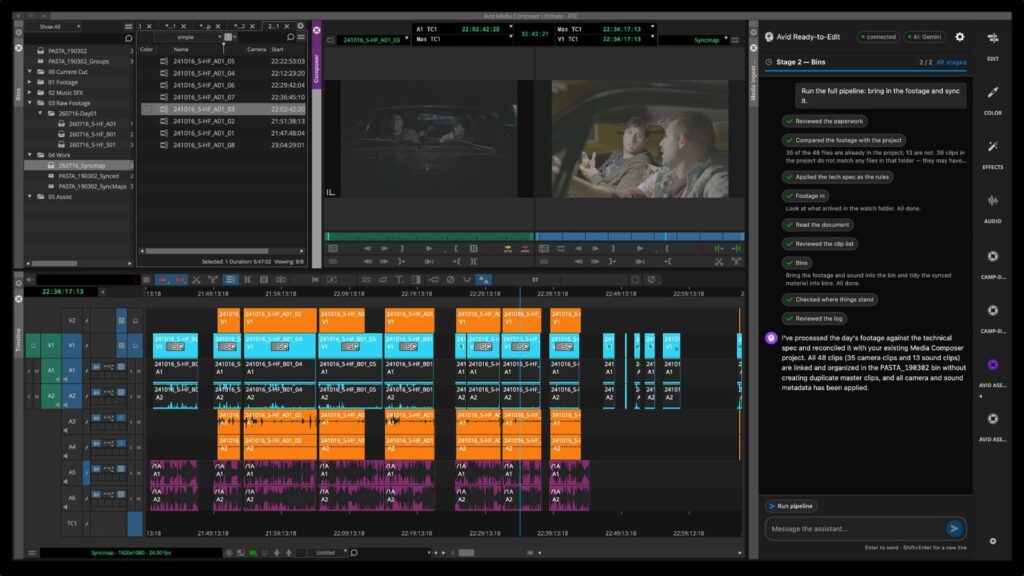
On 27 August Avid unveiled Media Composer 2026.8, the version it is taking to IBC in Amsterdam and that ships on 1 September. On paper it is an AI-heavy update, but the real story for anyone cutting in Italy sits in the licensing tiers: bin locking on third-party storage now belongs to the Enterprise tier only.
What actually changes: collaboration moves inside the software
Until now, putting two or three editors on the same project hosted on a NAS or on non-Avid storage meant NEXIS/ISIS emulation, or buying Mimiq at roughly $500 per licence. With 2026.8 that logic leaves the storage layer and moves into Media Composer itself: bin locking and Shared Projects become application features.
- Standard and Ultimate: bin locking and Shared Projects only on Avid storage (NEXIS), which now moves down a tier and is available from Standard upward.
- Ultimate: loses NEXIS/ISIS emulation, so no more bin locking on third-party storage.
- Enterprise: the only tier that collaborates on qualified third-party storage — EditShare, Facilis, generic NAS — and on cloud services such as LucidLink, Suite Studios and Shade.
Staying on your current version costs nothing: running projects keep working. The problem shows up at the first update. The figures circulating through reseller channels point to around $900 a year for Enterprise, with an upgrade from Ultimate near $99 — to be confirmed on the Italian price list, but that is the order of magnitude.
Our take from the field
In our opinion this cuts both ways. Taking Mimiq out of the equation does simplify life: one licence less to manage, one less component that breaks on a Friday night. On the other hand, small outfits — the two-suite post houses that are the norm in Abruzzo and central Italy — suddenly find the bill parked on a tier they never even looked at. If your workflow is “two editors, one QNAP, one shared project”, this is a new line to budget for in 2027.
The rest of the package is calmer. Ready to Edit is the agentic feature that preps material before the cut; PhraseFindAI Multicam Auto Cut builds the multicam following who is speaking and places cuts on speech boundaries, leaving the editor free to fix things by hand. On interviews and three-camera talks, that is the kind of automation that saves real hours. Then there are more mature transcript tools (revert edits, split segments, continuous playback), the OpenTimelineIO 2.0 adapter for exchanging timelines with other applications, bin column search and a few Titler+ fixes. The embedded Google Gemini panel, however, will be a technology preview in Amsterdam: do not count on it for September’s work.
One welcome note: Media Composer First, the free version, now carries the full core editing feature set, all codecs and formats, and its projects are compatible with the rest of the family. For anyone learning, it is the most honest way to get into Avid without paying.
What this has to do with the shoot
More than it seems: post decisions are made on set. If the cut is going to run on shared proxies in the cloud, organise data management during the shoot — tidy external recording, clean naming, double backup before you wrap. On our Atomos Ninja V we often record the ProRes files that end up being the edit master, while the Teradek Bolt 6 750 feeds video village and directing while the DIT works. And when the location is remote — normal when you shoot between the Marsica, Gran Sasso and the Costa dei Trabocchi — the Starlink kit lets dailies travel to the edit the same evening instead of waiting for the drive back to town. Complete packages are in our rental kits.
Official source: Avid — Media Composer What’s New. Verification and feature set details: Newsshooter.
A wide range of equipment in our catalogue, on-set delivery included across Abruzzo.