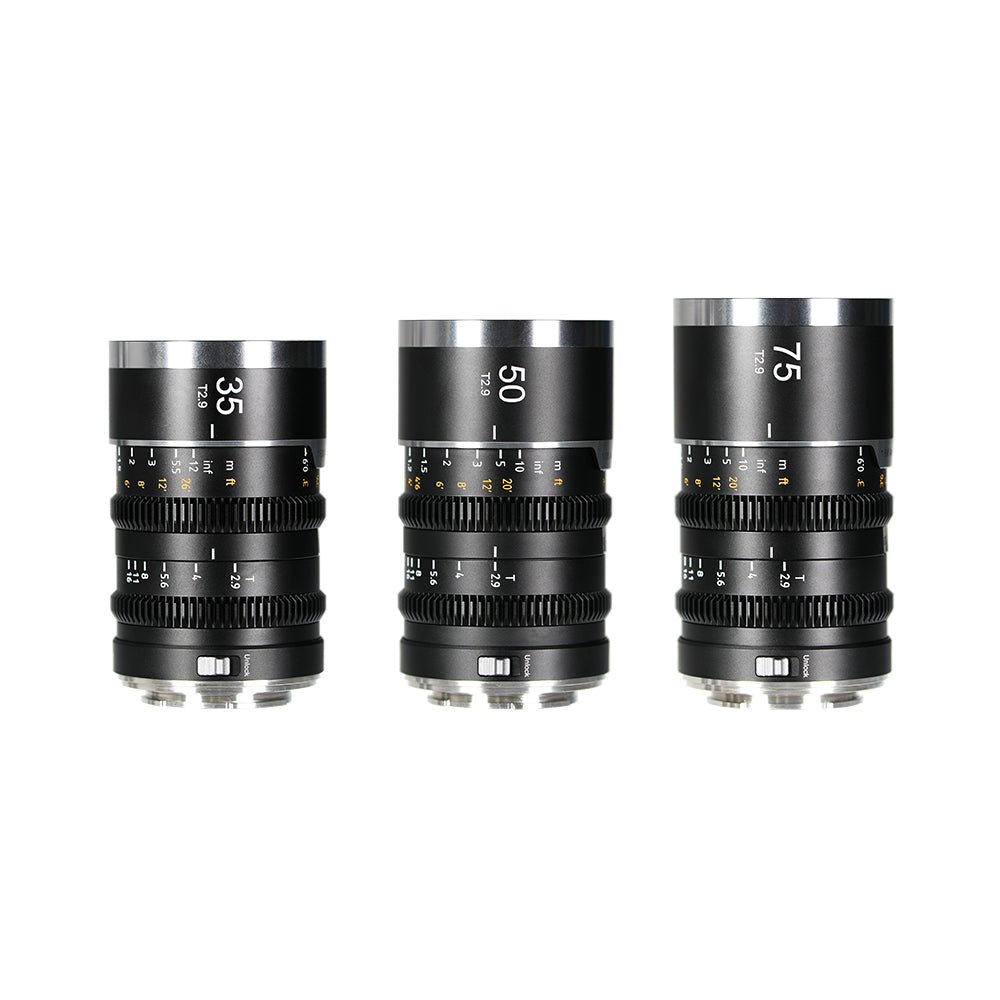
On 9 September SIRUI announced the Saturn V2: three full-frame anamorphics at 35, 50 and 75mm, 1.6x squeeze, constant T2.9. The price list says $599 per lens and $1,699 for the three-lens set. But the price isn’t the interesting part. The interesting part is that the optical block rotates, so the same lens goes from horizontal to vertical with a slider.
What that slider actually does
In a classic anamorphic, the cylindrical elements squeeze the image on the horizontal axis and that’s the end of it. SIRUI made the anamorphic group rotatable: release the catch, turn it, and the squeeze moves 90 degrees. You don’t pull the lens off the body and you don’t rebalance the gimbal. On a 16:9 sensor shooting horizontally, the desqueezed result is 2.84:1; if your camera gives you 3:2 open gate you land on 2.4:1, which is where most of us actually finish. Shoot vertical and the maths flips: 9:16 becomes 0.9:1, so nearly square.
Honestly: this is a feature built for people delivering the same footage in two formats. A commercial that lives on YouTube and on Reels, a behind-the-scenes, branded content. For a short film or a music video that is born and dies in 2.4:1, you’ll never touch the slider. That’s fine, but it’s worth knowing who these were designed for.
Numbers that matter on set
- Weight: between 437 and 507 grams in L-mount. These are anamorphics that sit on a light gimbal without an argument.
- Length: 100.9 to 112.2 mm, so the set is consistent and a lens swap doesn’t mean rebalancing from scratch.
- Iris: 10 blades, T2.9 to T16.
- Mounts: Sony E, Leica L, Canon RF. Z-mount is stated to be in development.
- Filters: 62mm thread, 65mm front on all three. One filter set covers the whole kit.
- Coverage: image circle up to 45mm, so genuinely full frame.
Buy them or rent them?
Here the answer is different from usual. A serious anamorphic set starts in five figures: $1,699 for three focal lengths is another league entirely. If you shoot anamorphic every month, in our view you just buy them, no need to overthink it.
It changes if anamorphic is something you reach for on the right project rather than out of habit. A music video, a commercial, a short: in that case you pay for three rental days instead of tying up capital in manual glass that will have a V3 sitting above it in two years. And renting means you get to choose the character: the Saturn V2s are compact and well behaved, other anamorphics are far dirtier and more opinionated. Those are two different films. Buy, and you marry one look; rent, and you pick it per project.
Three practical warnings
First: check your camera has a 3:2 open gate mode, otherwise the 16:9 gives you 2.84:1 in the timeline and you have to decide whether to keep it or crop. With a Sony FX3 or a Sony FX6 it’s worth thinking that through before the shoot, not after.
Second: a monitor with 1.6x desqueeze. Not every monitor has it in the presets, plenty stop at 1.33x and 2x. Without proper desqueeze the director watches squashed faces for eight hours and the conversation gets difficult.
Third: they’re manual, full stop. No autofocus, no communication with the body. If you’re used to working alone on AF, with these you need a focus puller, or at least a follow focus and a bit more discipline.
What we pair them with
The low weight makes them a natural fit on the DJI RS 3 Pro, the gimbal that leaves our shelves most often. On compact full-frame bodies the combination even works handheld, which you can forget about with a traditional anamorphic set. Everything else you’d build a kit around is in our rental gear list.
They’re on the official SIRUI site, and the technical details were also covered by Newsshooter.
A wide range of equipment in our catalogue, on-set delivery included across Abruzzo.