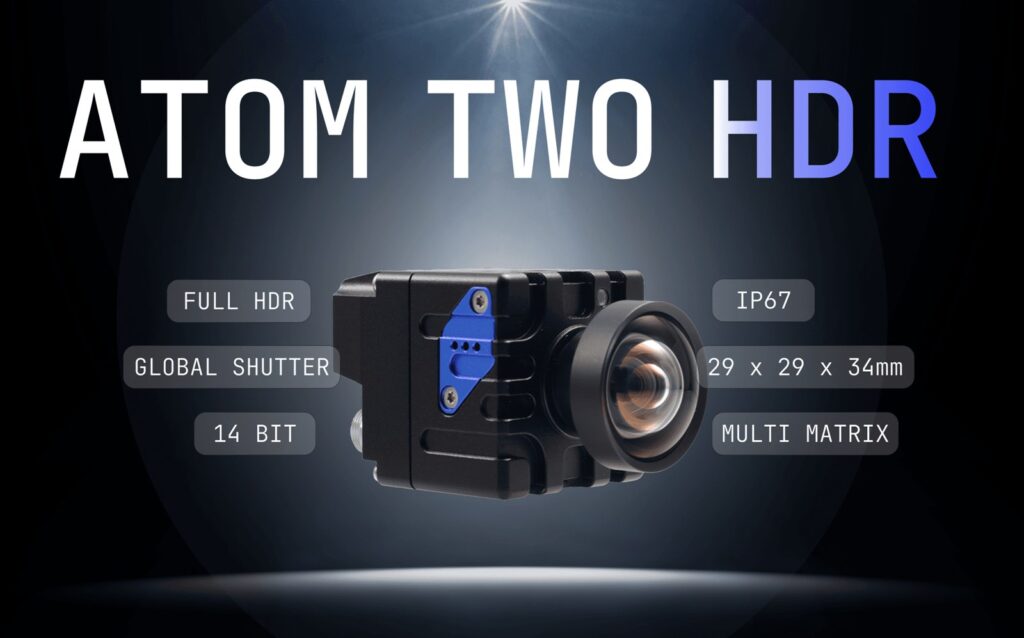
At IBC 2026 Dream Chip unveiled the ATOM two HDR, and the news isn’t the body size — we already knew that part — but what they managed to fit inside it: 14-bit dynamic range with 16-bit internal processing, HLG, PQ and S-Log3 curves, in a 29 x 29 x 34 mm cube that weighs 53 grams without a lens. Announced on 11 September, shipping in October, list price $1,899.
POV mini cameras have always been the ugly part of the footage: you mount them where a real camera won’t fit, then in post you hide them in the cutting because they can’t stand next to the A-cam. With 14-bit S-Log3 that conversation changes, at least on paper.
The specs that actually matter
- 1/1.8″ global shutter sensor — no jello, no leaning verticals under vibration
- 14-bit quantisation, 16-bit internal processing, multi-matrix at 12/24/32 angles
- HLG, PQ and S-Log3: it drops into HDR pipelines and grades alongside Sony bodies
- 1920×1080, 23 to 60 fps (progressive and interlaced)
- Base ISO 140, maximum 6400 analogue
- Interchangeable S-Mount (M12), 4.2 mm lens as standard with an 85° field of view
- One 3G-SDI output, RS-485 control over a Lemo connector, 12-24 V power
- IP67 body: rain, spray, mud
The limitation to face head on: it’s Full HD
1920×1080 and that’s it. If you deliver in 4K — and these days you almost always do — this isn’t a B-cam, it’s an insert. On short cuts inside a fast edit nobody notices; on a ten-second static shot they do. Our take: treat it the way 16mm was treated next to 35mm — a different texture, used on purpose, not as a fallback.
The other thing to budget for is that it records nothing on board. SDI out and that’s the end of it. So you need a recorder, a switcher, or a wireless link: all three weigh more than the camera itself.
Where we’d genuinely use it
Cockpit, handlebars, mounted on a moving car, inside a rostrum, above a doorway, in a corner where the rig won’t go. The global shutter is the reason you pick it: on a car, on an engine, on a fairground ride, a rolling sensor hands you footage you have to throw away. This one doesn’t.
In Abruzzo the obvious use isn’t live football but everything shot in awkward places: rallies and hillclimbs, mountain sports, guided tours in caves and mines, production lines inside factories, wherever you need a viewpoint an operator can’t physically hold. The IP67 rating isn’t marketing: on a special stage with water coming in sideways it’s the difference between shooting and not shooting.
Buy it or rent it
$1,899 is the body. Add alternative S-Mount optics, Lemo cables, decent power (a V-mount with a regulator, not any old battery) and the chain downstream — recorder or transmitter. If you shoot motorsport every week you buy it and write it off in a season. If you need it for two days on a commercial, or for one sequence in a documentary, you’re throwing money away: that same figure in rental covers the whole crew, not one 53-gram accessory.
We’re watching this one for October. In the meantime, if a production needs an impossible viewpoint, we take a different route: start from the main body — a Sony FX6 or a Sony FX9, which in S-Log3 marry up with any Dream Chip mini camera without a colour fight — and add a Teradek Bolt 6 750 to get the SDI signal out of the rig without running cable. The rest of the inventory is on the equipment page.
Official source: Dream Chip / Atom Camera. Verification and first hands-on from IBC 2026: Newsshooter.
A wide range of equipment in our catalogue, on-set delivery included across Abruzzo.