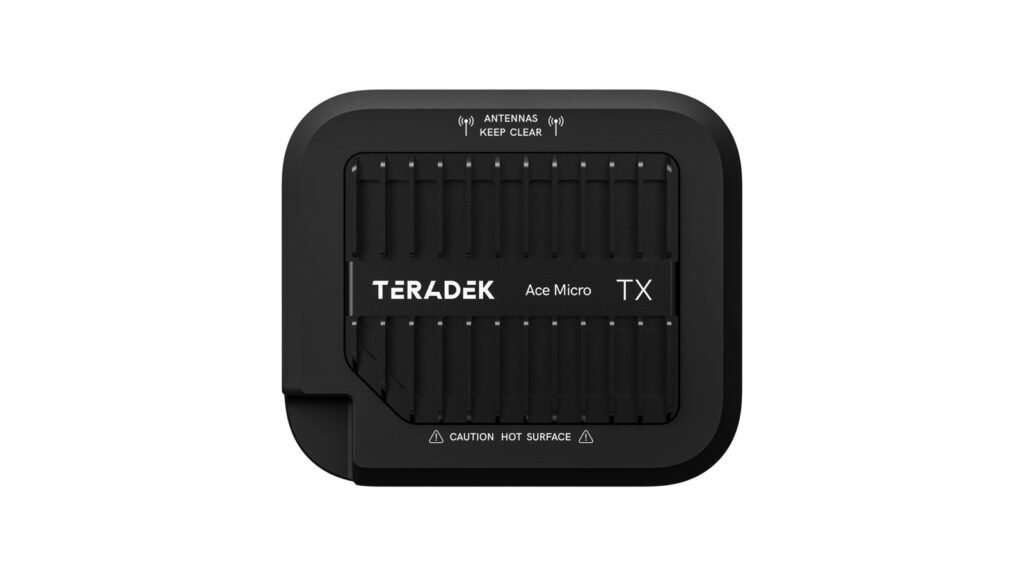
Teradek listed the Ace Micro TX on 10 September and had it on the stand at IBC 2026 a few days later. It is the smallest zero-delay transmitter the company has built so far: $599, internal antennas, and a single USB-C cable carrying video, power and communication. Shipping is announced for October.
For once, the price is the least interesting part. What matters is what sits inside.
The same chipset as the Bolts
Ace Micro TX shares the BB3 chipset with Bolt 4K, Bolt 6, Bolt 7 and Ace 750. In practice it transmits to the receivers of those systems with no adapters, no second kit and no change of habits. Teradek quotes uncompressed 4Kp30 to as many as six receivers, range up to 150 metres, sub-millisecond latency and automatic selection between 5 and 6 GHz on the cleanest channel.
That is where it gets interesting for a rental house. If a Teradek Bolt 6 750 is already on set, the second camera no longer needs a complete wireless system of its own: one extra transmitter does the job, at accessory money and in your pocket. Nothing changes at the video village, the monitors stay the same, the operator learns nothing new.
One cable, and who really benefits
On cameras that support DisplayPort Alt Mode over USB-C – Teradek explicitly names Blackmagic URSA Cine and PYXIS – the transmitter hooks up with one cable and that is it. No SDI, no separate power, no mounting plate. On an URSA Cine 12K already loaded with accessories that is one less thing hanging off the rig, and anyone who has built a documentary setup knows how much “one less thing” is worth.
Then there is the iPhone. With the Ace Micro TX connected over USB-C the phone joins the wireless ecosystem like any other camera, using whatever capture app you prefer, and the signal reaches the monitors without Wi-Fi lag – Teradek claims latency over 70 times lower than Wi-Fi based solutions. For behind-the-scenes, for a vertical second angle aimed at the client’s social channels, for a hidden camera position where a cine body simply does not fit, it is a genuinely useful shortcut.
Three things to know before you rig it
- It wants its own power. External USB power is mandatory. It will not drain the camera battery, but a power bank or a V-mount with USB-C output has to be part of the rig budget.
- The antennas are internal. Handy on a gimbal, where on a DJI RS 3 Pro nothing sticks out and catches any more. It also means placement matters: squeezed between two metal plates, real-world range will not match the spec sheet.
- It stops at 4Kp30. Shooting 4K at 50 or 60 fps means setting the output accordingly. For monitoring that is rarely a problem, but it is better to find out beforehand rather than on set.
In the box there are two right-angle USB-C cables (12 and 18 inches) and a Wooden Camera adapter plate. The product code is 10-2246.
How we read it
The productions we serve here in Abruzzo are almost always two-camera jobs with a short crew. On a two-day commercial the cost of a second complete wireless system never adds up: you end up sending only the A camera to the monitors and leaving the B blind, with the director turning around to squint at the on-board screen. A $599 transmitter that talks to receivers already on the truck changes that maths – and it changes it most of all on rental, where the client pays by the day and amortises nothing.
We are looking at it for our own inventory as soon as it lands in Europe, with one reservation: a unit this small, with a USB-C cable as its only point of contact, also means budgeting for broken cables and lost adapters. In the meantime, the wireless video we rent today sits alongside the rest of our equipment in the catalogue.
Official source: Teradek Ace Micro TX product page. Industry verification: Newsshooter.
A wide range of equipment in our catalogue, on-set delivery included across Abruzzo.