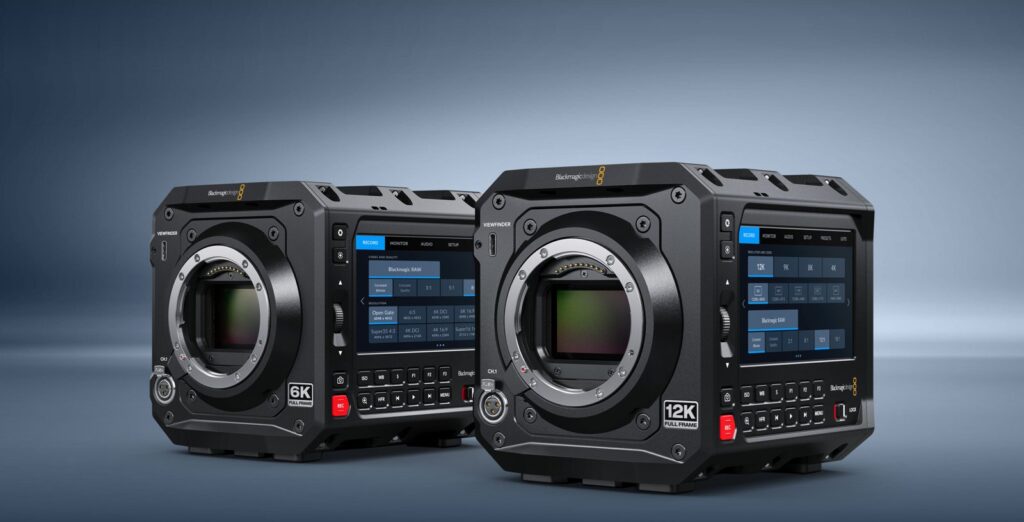
Blackmagic has put out a test build that brings phase-detect autofocus to the PYXIS 12K. It is the first time, and it is not a footnote in a release note: until now PDAF on Blackmagic cameras was a Bayer-sensor affair, and nobody had ever confirmed that the 12K’s RGBW sensor had the phase pixels to make it work.
What is in the build
The version is Blackmagic Camera 10.2.96 and it adds PDAF to the PYXIS 12K with the same feature set and controls already shipping on the Cinema Camera 6K and the PYXIS 6K: continuous autofocus, face detection, object tracking and a resizable focus box. That replaces the old single-shot contrast system, which was close to useless on moving subjects.
Two warnings, and they come from Blackmagic itself. First, this is a test build, not a public release, so it belongs on an evaluation body and not on a paid job. Second, only the Mac installer exists right now, because the Windows one is broken. Distribution goes through a dedicated thread on the official forum, where the company is collecting tester feedback. If anything goes wrong you roll back by downloading the latest general release from the support site and running the updater on the camera.
Why the sensor question stayed open
When the PYXIS 12K was announced, Blackmagic had already warned that getting decent phase-detect autofocus onto it would take serious engineering: RGBW is a different technology from the Bayer sensor shared by the Cinema Camera 6K and the PYXIS 6K. Meanwhile the smaller siblings moved on — PDAF as a test build on the PYXIS 6K in March, then a stable release with Camera 10.2 in June — and the 12K sat still. The longer it went, the more it looked like that sensor simply had no phase pixels. Now we know: it does.
It matters more on a box body
This is the real point, in our view. On a shoulder-operated cine camera autofocus is a convenience; on a box body like the PYXIS it is part of the workflow. That form factor almost always ends up where nobody is standing behind the camera pulling focus: gimbals, remote heads, crash cams, a second camera on a multicamera interview, shooting driven from the Blackmagic Camera app. In all of those setups reliable continuous AF stops being a compromise and becomes the default. Solo operators — and in Abruzzo that is most documentary and small commercial work — notice it at the end of the day, when they count how many shots they threw away.
How we see it as a rental house
We are careful with firmware on rental bodies by profession, and this time more than usual: a test build on a camera that goes out to work every day is a risk with no upside. The practical advice, if you update your own body, is to keep it off paid sets until the general release lands, and to remember that the forum thread is the right place to report odd behaviour. Anyone renting from us does not have to think about it: our cameras go out on stable firmware and we tell you which build is on them.
On the wider question, what we keep repeating still holds: if you need a 12K for a project, do the maths on how many shooting days you will actually get out of it before you sign a purchase order. The box-camera segment moves fast and firmware reshuffles the deck every few months. If you need the top of Blackmagic’s resolution range for a specific job, our list includes the Blackmagic URSA Cine 12K; for the setups where continuous autofocus really earns its keep we usually pair it with the DJI RS 3 Pro and, when the camera ends up on a remote head or far from video village, the Teradek Bolt 6 750. The rest of the fleet is on our equipment page.
Official source: Blackmagic Design forum test thread. Verification: CineD.
A wide range of equipment in our catalogue, on-set delivery included across Abruzzo.