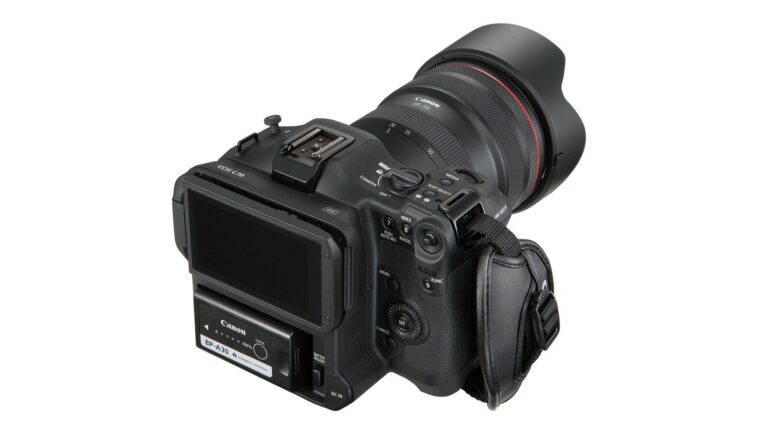
Since the Canon EOS C80 joined our inventory, almost everyone who calls about a Canon asks the same thing: C70, or should I step up? Our answer is hardly ever «the newer one». Here is how we think about it, with both bodies in the house and coming back from set every week.
What the C70 still does very well
The Canon EOS C70 uses a Super 35 sensor with DGO technology: every frame is read out at two different gains and recombined, for a claimed 16+ stops of dynamic range in Canon Log 2. On set that means clean shadows and highlights that do not fall apart — the reason a camera launched in 2020 never ended up at the back of the shelf.
- Just over a kilo of body, RF mount, the handling of a chunky mirrorless.
- Internal mechanical ND filters: 2, 4 and 6 stops, extendable to 10.
- 4K up to 120p and 12-bit Cinema RAW Light, on two SD slots.
- Two mini-XLR inputs with phantom power: usable sound without an external recorder.
- Dual Pixel CMOS AF with Eye AF, plus Netflix approval for 4K Originals.
Where the C80 genuinely wins
The C80 is full frame 6K with a stacked BSI sensor, triple base ISO at 800, 3200 and 12800, internal 6K Cinema RAW Light and a 12G-SDI output. Three differences actually show: night work (that third base ISO holds clean log where the C70 starts to struggle), multicam and live integration thanks to SDI, and full-frame field of view when the client wants that look. Everything else — Canon colour, autofocus, ND, workflow — is close family.
The price does change: we rent the C70 at €90 a day, €215 for three days, €360 a week; the C80 at €120, €300 and €400. Over a week that is €40 apart. If the job justifies it, step up without thinking twice. If it does not, the C70 will not leave you wanting.
When we pick the C70
Four cases, in our experience. One-day interviews and corporate work, where you build and roll in ten minutes. Two-person documentary, because weight really does matter after eight hours. Cinematic weddings, where internal ND and reliable AF save the ceremony. And as a B-cam next to the C80: same colour, same menus, same RF glass, and no chasing two different matrices in the grade.
Three things we tell people on set
- The ND is mechanical, not electronic. It steps, it does not ramp: if you come from a Sony with variable ND, keep that in mind on fast lighting changes.
- Above 60p the DGO readout is out. Dynamic range drops for high frame rates, so expose with a little more headroom and do not lift the shadows in post.
- The cards. You need genuine V90 SD media, and Cinema RAW Light fills them fast. Bring twice as many as you think, or ask us for them with the body.
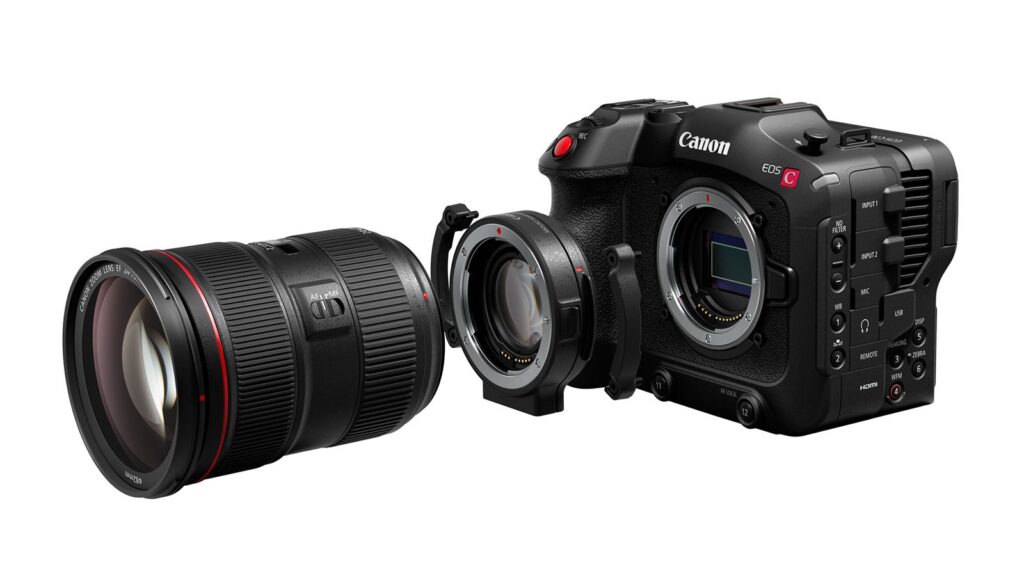
One more: the EF-EOS R 0.71x adapter recovers almost the full-frame field of view of EF glass and gains you roughly a stop of light. It is the pairing we hand over most happily to anyone who already owns EF lenses.
Why rent it, here in Abruzzo
A new C70 body runs around €5,000, before the adapter, fast cards, batteries and monitoring. At four or five shoots a year the maths does not work: your capital sits still in a body that depreciates while it sleeps in a cupboard. Renting, you pay for it only on the days it earns, you bill it to the production, and we bring it to set — delivery included anywhere in the region.
What we pair it with
For interviews an Aputure LS 300x as key light is plenty; for monitoring and a second codec we add an Atomos Ninja V. Body, glass and accessories are ready to go in our rental kits. Full official specs live on the Canon EOS C70 page; for measured numbers, the CineD lab test is still the reference.
Send us a couple of lines about the project and we will tell you whether the C70 is enough or it is worth stepping up this time.
A wide range of equipment in our catalogue, on-set delivery included across Abruzzo.