Looking back at our rental log for the past year, the item that goes out and comes back most often isn’t a camera body: it’s a gimbal. The DJI RS 3 Pro has become our workhorse, so it’s worth explaining why we recommend it so often — and, more importantly, when it’s the wrong call.
What sets it apart from creator gimbals
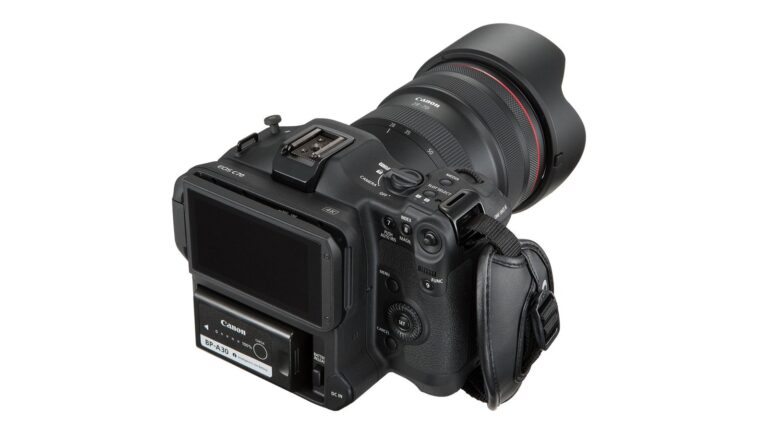
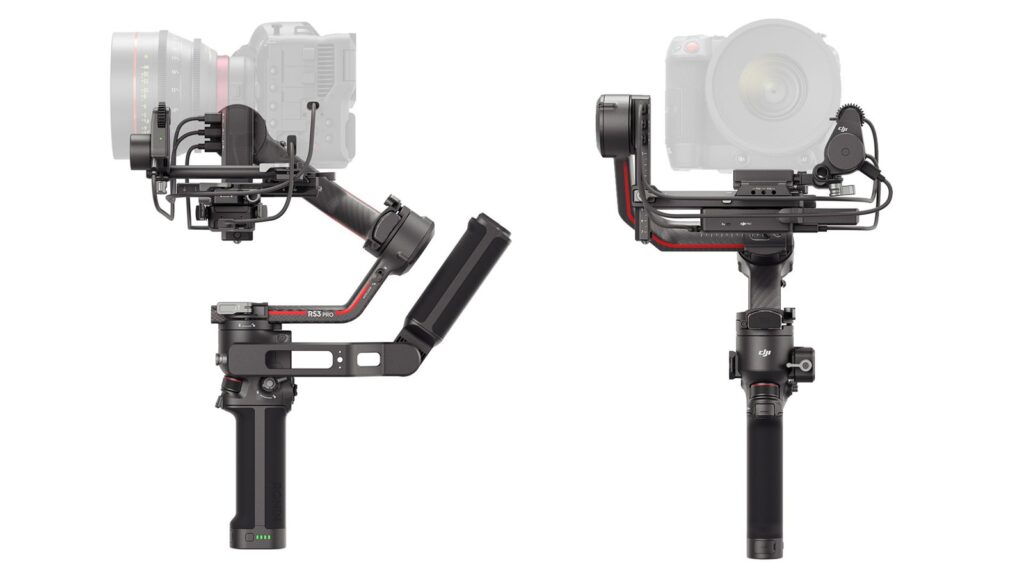
The number that matters is the tested payload: 4.5 kg. That sounds generous on paper, but it disappears fast on set. Body, fast lens, monitor, video transmitter, follow focus motor: you hit three and a half kilos without noticing. The RS 3 Pro keeps some headroom because its arms are cut from a single piece of carbon fibre — the same approach as the Ronin 2 — and they’re longer than on the standard RS 3. That extra length is the practical reason you can balance a Sony FX6, a Canon EOS C70 or a RED KOMODO 6K without pushing the lens right up against the motor.
The rest you already know: 1.8″ OLED touchscreen, automated axis locks, up to 12 hours of battery life. Those automated locks read like a brochure detail until you do eight setup changes in one day — then they’re ten minutes back in your pocket.
Who it actually suits
In our experience the RS 3 Pro shines on three kinds of job. Commercials and branded content, where you need clean, repeatable moves without hauling a dolly. Documentary and corporate work, when you have to follow someone walking through a factory floor or a hill town and there’s no time to lay track. Music videos and cinematic weddings, where constant movement is part of the language.
It’s not worth it if your shot list is all locked-off tripod work — that money belongs on a lens or a light instead. And it’s not worth it if your rig comfortably clears four and a half kilos: at that point you move up to a Ronin 2 or a Steadicam.
Why renting beats buying
A gimbal ages faster than anything else in the kit. Good cameras stay in the catalogue for years; stabilisers change generation every two, and meanwhile the batteries degrade whether or not the unit leaves the cupboard. Ours goes out at €55 per day, €140 for three days, €220 per week. Count the days you genuinely need one over a year: if it’s fewer than twenty, buying means tying up capital in something that loses value while it sleeps. On top of that, a rental comes back balanced, with current firmware and healthy batteries — worth more on set than it sounds.
Three things to know before you shoot
- Balance with the full rig. The classic mistake is balancing with body and lens only, then bolting on the monitor and transmitter at the last minute. The gimbal still holds, but the motors run hot and battery life collapses.
- LiDAR isn’t magic. The Range Finder projects tens of thousands of ranging points across a few metres and gives autofocus to manual lenses: it works well at medium distances, less so in strong backlight or on very distant subjects. Treat it as an excellent assistant, not a focus puller.
- The weight tells after twenty minutes. The unit alone is around 1.5 kg, plus the camera. For long days ask us for the dual-handle grip or a support vest: it costs little and changes how the day ends.
What we pair it with
The combination that leaves the warehouse most often is RS 3 Pro plus an FX6 with a light zoom. Two-person crews add the DJI RS 3 Mini as a nimble B unit. It ships with plates, extended base and case; everything else is in our equipment catalogue or in the complete kits, and delivery to set anywhere in Abruzzo is included.
Full specifications are on the official DJI page; for a technical breakdown from launch, CineD‘s coverage still holds up.
A wide range of equipment in our catalogue, on-set delivery included across Abruzzo.