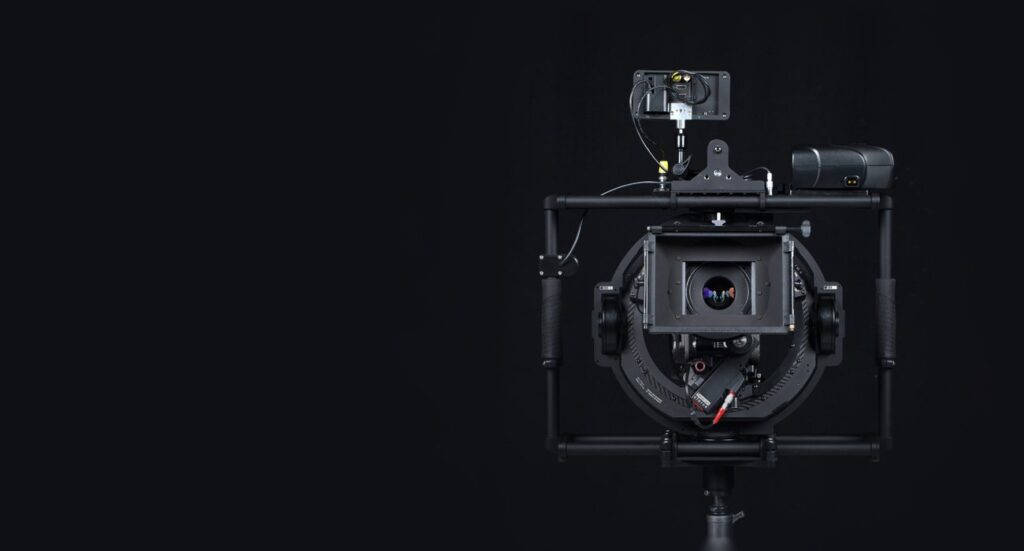
FoMa Systems has announced the Maxima Mk II: the ring-architecture gimbal that raised the bar for handheld payload back at IBC 2014 is going back into production. The original had been discontinued for years — you could only find it used, or in ARRI’s legacy listings, since ARRI distributed it — and according to the company it was persistent demand from operators that brought it back.
The numbers are the ones that matter if you work with real camera packages: 30 kg of rated payload against a 7.5 kg system weight, a 4:1 ratio. To put it in context, it weighs about as much as a DJI Ronin 2 with its frame, but carries more than twice the load. This is not a mirrorless gimbal: it is built around a full build — cinema body, big zoom, mattebox, motors, transmitter, battery — without stripping the camera down to fit the spec sheet.
What changed from the original
The mechanics are unchanged: closed-ring architecture, precision bearings, high-torque brushless motors. Everything electronic has been rebuilt.
- Native 24 V electronics, with a claimed 50% more torque on every axis; B-Mount and Gold Mount Plus plates, with 12 V down-conversion for camera and accessories.
- Autotune PID: retune the system for each camera and lens combination without connecting a computer.
- FoMa RCP Lite, the new controller: integrated display, Mimic Control (move the controller, the gimbal follows) and compatibility with NODO Inertia Wheels, ARRI Digital Wheels, PLC Wheels and the FoMa PanBar.
- Frequency-hopping 2.4 GHz wireless up to 1 W of transmission power where regulations allow.
- EvolveOS onboard: saved profiles and system monitoring from the display on the head, no external software.
The detail that actually pays off on set, inherited from the first Maxima, is balancing with only two adjustments: fore/aft and side-to-side. On a conventional L-shaped design, swapping a filter or adding a focus motor sends you chasing the centre of gravity across several axes. Here you have two variables, then you Autotune and go back to shooting. Over a full day, that is minutes saved on every lens change.
Price, availability and what it means for us
The Complete Kit — gimbal, battery plate, RCP Lite, 315 mm dovetail and 12 V and 24 V camera cables — costs EUR 13,750 worldwide (USD 14,990 in the US), taxes and any tariffs excluded. Production is a limited run: FoMa states plainly that once the units allocated to this edition are gone, no further batches are currently planned. Expected availability is at the end of Q1 2027.
In our view this is exactly the kind of tool that makes no sense to buy unless you keep it working all season. Nearly EUR 14,000 plus VAT, delivered more than a year from now, only pays for itself if the heavy gimbal goes out dozens of times a year; for a commercial, a music video or two days of second unit, renting is the only maths that holds up. And it is worth repeating: a 30 kg payload head earns its place when the camera build really is heavy — an ARRI ALEXA Mini with zoom and mattebox, or a Blackmagic URSA Cine 12K in full configuration. With a bare Sony FX3 you are using a cannon on a mosquito, and the DJI RS 3 Pro does the same job at a tenth of the footprint.
The other practical point, for anyone shooting in Abruzzo: a system like this needs an operator who knows it. The learning curve of a 7.5 kg ring gimbal is not something you absorb on the shooting day, and the real cost is not the head rental but the operator’s day rate. If you are planning a complex move — dolly work on dirt roads, vehicle shots on the Gran Sasso passes, handheld in tight interiors — bring it up in prep, not on the morning of the shoot. In the meantime, if you just need to stabilise a light build, our kit catalogue already covers most real-world cases.
Official source: FoMa Systems. Verification and pricing: Newsshooter.
A wide range of equipment in our catalogue, on-set delivery included across Abruzzo.