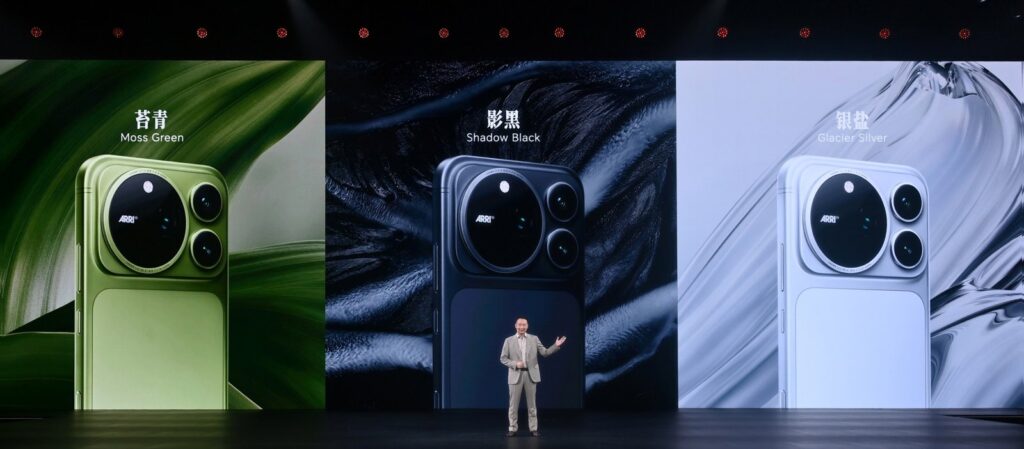
On September 28 HONOR launched the Magic9 Pro Max in China, and this time the ARRI logo isn’t just in the press release: it’s printed on the phone and on the box. What matters to us, though, isn’t the badge. It’s that the phone records ARRI LogC3 in ARRI Wide Gamut 3, the same encoding that comes out of an ARRI ALEXA Mini.
What it does, by the numbers
According to HONOR’s official announcement, the ARRI CINEMA mode records as follows:
- up to 4K at 60 fps, 10-bit, in LogC3 and ARRI Wide Gamut 3;
- 14 ARRI Looks on board for real-time preview, plus 87 grades from the ARRI Look Library;
- manual control of shutter, ISO, white balance, focus, aspect ratio and stabilization;
- 200MP main camera on a 1/1.28″ sensor at f/1.57 with OIS, 200MP telephoto on a 1/1.4″ sensor at f/2.6, 50MP ultra-wide at f/2.0;
- 14 stops of dynamic range, as claimed by the manufacturer.
As reported by CineD and other trade outlets, recording is 10-bit 4:2:2. In China it starts at 6,499 yuan. For Europe, HONOR only says the launch is to be announced: you can’t buy it in Italy today, and there’s no euro price.
Why LogC3 matters more than the phone
Anyone shooting on the ALEXA Mini has lived in LogC3 for years: on-set LUTs, the DP’s look, transforms in DaVinci, everything is built around that curve. Until now every “extra” camera on an ARRI set (action cam, drone, a phone as crash cam) came in with its own log, and in the grade you had to chase it by hand to sit next to everything else. If the Magic9 really records in the same curve and gamut, the same LUT applies to both sources and the colorist starts from a much closer place.
In our view that’s the point: this isn’t a phone that “replaces” a cinema camera, it’s a phone that speaks the same language. A different thing, and a far more useful one.
Where we see it on set
- Crash cam and impossible spots: inside a car, under a wheel, strapped to a pole, where you’d never put a camera worth tens of thousands of euros.
- Behind the scenes and social verticals for the same production, with a look already consistent with the main footage.
- Location scouting: test shots the DP can review with the film’s LUT already on.
The caveats, from the field
A 1/1.28″ sensor is still a 1/1.28″ sensor. The curve may match, but shadow noise, rolling shutter, highlight handling and fine detail won’t: the ALEXA Mini has a Super 35 sensor behind it and processing no phone has. The 14 stops are HONOR’s figure, to be checked against the independent tests that will follow. And until the phone officially lands in Europe, for an Italian production it’s news, not a tool.
Then there’s media management: on set the main camera’s cards follow a strict backup workflow, the phone doesn’t. If it goes into production, someone has to treat it like a real camera.
What it means for shooting in Abruzzo
For now, nothing concrete, and it’s fair to say so. But the direction is clear: ARRI is taking its color science beyond its own cameras, and LogC3 is becoming a wider interchange format. For anyone renting an ALEXA Mini for a commercial, a short or a music video, it means the “supporting” cameras will fit into the grade better and better.
Meanwhile, if you need a second source that sits next to the ALEXA without surprises, the solid route is still a real cinema camera as B-cam: the Sony FX3 for tight spots and gimbals, with an Atomos Ninja V to load the same LUT on the monitor and see the look while you shoot. Everything else is in our rental gear: call us before the shoot and we’ll build the package together.
A wide range of equipment in our catalogue, on-set delivery included across Abruzzo.