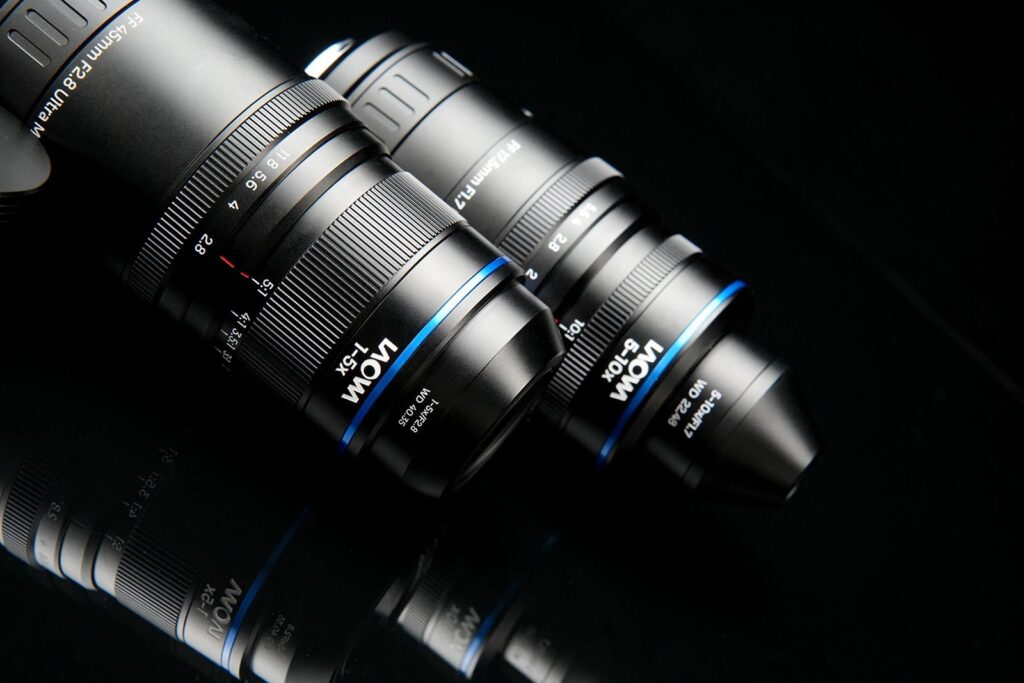
On July 31 Venus Optics announced the Laowa Aksen series: two variable-magnification ultra macro lenses, a 45mm f/2.8 1-5x and a 17.5mm f/1.7 5-10x. Put like that it sounds like gear for entomologists, and partly it is. But two details matter a lot to anyone shooting commercials, packaging or food: they are parfocal, and the cine versions come in PL mount.
Why parfocal changes the job
On a conventional macro lens, changing magnification means moving the camera, re-racking focus and rechecking your lighting. On the Aksen lenses the barrel does not extend, the zoom is internal and the working distance stays fixed: 40.35mm on the 1-5x, 22.48mm on the 5-10x. Because they are parfocal, focus holds as you go from 1:1 to 5:1.
On set that means the magnification move becomes a shot you can actually roll on, instead of something you rebuild in post with a micrometric slider and focus stacking. More importantly, once the light is set it stays good across the whole range, because the front of the lens never gets closer to or further from the subject. In our view that is the real value here, far more than the headline: yes, the 17.5mm is the first commercially available lens covering 5-10x, but what saves you hours is the repeatability of the setup.
Announced specifications
- Aksen 45mm f/2.8 1-5x: 13 elements in 9 groups, 11-blade diaphragm, f/2.8-f/11, 70.2 × 121mm, 599g, 56mm front filters (37mm rear filters on the PL version).
- Aksen 17.5mm f/1.7 5-10x: 17 elements in 12 groups, f/1.7-f/5.6, 11 blades, 70.2 × 127.5mm, 570g, 42mm front filters.
- Full-frame coverage on both, APO design. The cine version has an Arca-Swiss compatible collar and 15mm rod support, so you get a proper follow focus rather than a workaround.
- Announced pricing: 749 dollars for the photo version, 1,499 dollars for the PL cine version. European pricing and real-world availability are still to be confirmed; pre-orders are already open.
- Photo mounts: Sony E, Nikon Z, Canon RF, Leica L, Nikon F, Canon EF, Fujifilm X and Micro Four Thirds. Cine: PL.
Who would actually use this in Abruzzo
There are more detail-driven productions around here than people assume: wineries, pasta and olive oil producers, cosmetics, goldsmithing, precision engineering. These are jobs where the client wants to see the texture of the pasta, the bubble in the glass, the thread on a machined part. Until now those shots were done with a 1:1 macro and a lot of patience; with a lens that reaches 5x while holding focus, the insert shot becomes a different animal.
The PL versions mount straight onto a body like the ARRI ALEXA Mini, while a RED KOMODO 6K needs a PL adapter, which is a well-tested route for table-top work anyway.
Two things that worry us
The first is light. At 5x, and even more at 10x, the effective aperture collapses and that f/1.7 on paper is not the transmission you end up with on the sensor. You need a lot of light and you need it small, because with 22mm of working distance there is no room for a softbox: in these situations we work with an Aputure LS 300x bounced, or with a Nanlite Forza 720 plus fibre optics or a snoot when we really need to push.
The second is vibration. At those magnifications depth of field is measured in tenths of a millimetre and a truck going past outside will ruin the take. Heavy bench, stable floor, and ideally motorised movement: handheld is out of the question.
Buy or rent
1,499 dollars per lens for the PL version is not crazy money, but this is a specialist optic: if you shoot table-top twice a year, that cash sits in a cupboard eleven months out of twelve. Buying only makes sense if product work is your bread and butter. For everyone else the answer is to put it on a single production together with the right body and the right light, which is exactly the reasoning we go through whenever someone asks us to quote a two-day commercial. We are evaluating the series for our lens inventory: in the meantime, if you have detail work coming up, have a look at the equipment we can pair with it.
Official source: Venus Optics. Verification and first images at PetaPixel.
A wide range of equipment in our catalogue, on-set delivery included across Abruzzo.