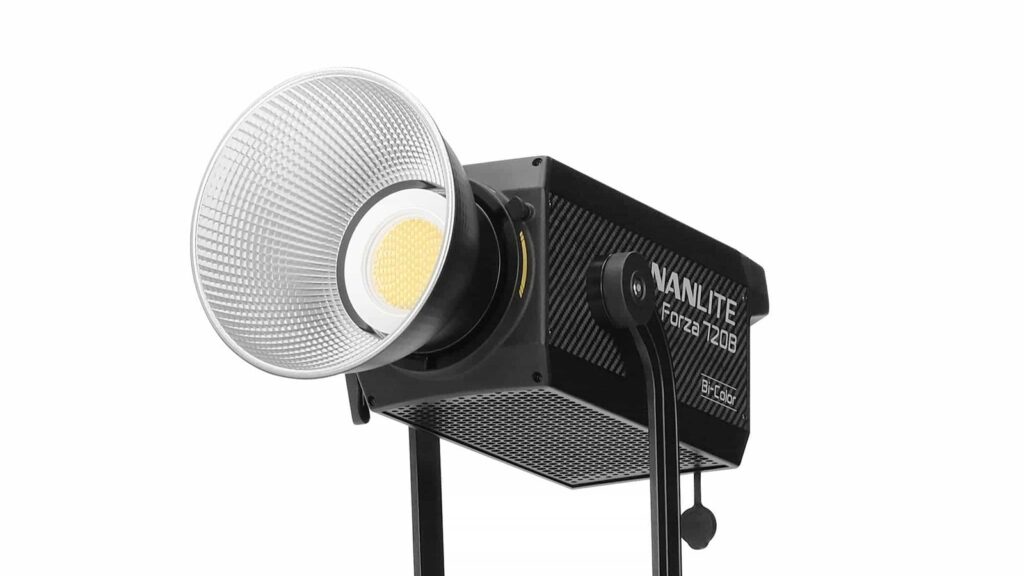
When a production calls and says “we need a light that comes through the window and holds up against the sun”, the answer in our warehouse is almost always the same: the Nanlite Forza 720. It is the most powerful monolight we keep in stock and, in our view, also the most misunderstood item in our lighting catalogue: plenty of people ask for it for small interiors, where half the output would do, and hardly anyone asks for it for backlit exteriors, which is exactly the job it was built for.
What 800W of LED actually means
The Forza 720 draws 800W and, in the daylight version with the supplied 45° reflector, reaches 124,000 lux at one metre. The bicolour 720B stops at 84,460 lux: that is the difference most people forget when choosing, and you notice it on set. In practice the daylight 720 is a serious replacement for a 2.5 kW HMI in the way we use it — no ballast, no spare bulbs, no warm-up time.
- 800W draw, dimmable from 0.1 to 100% in 0.1 steps
- Forza 720: 5,600 K, CRI 95 / TLCI 96 — Forza 720B: 2,700-6,500 K, CRI 96 / TLCI 97
- Bowens mount, so every standard modifier fits
- Mains power or two V-Mount batteries (14.8 V or 26 V)
- Split body: 4.8 kg head, 4.2 kg control unit
- Onboard panel, Bluetooth, 2.4 GHz, DMX and RDM control
Who it suits, and who it doesn’t
It makes sense on commercials, music videos and shorts where you have to beat the sun or fill a large interior from outside, through a window or a diffusion frame. It also makes sense on documentaries in industrial spaces and warehouses, where you cannot get close to the subject and you need throw. It makes no sense for an interview in a four-metre room: there it is too much light, you run it at 15% and pay for power you never use. For those jobs we point people at the Aputure LS 300X, which is easier to handle and cheaper per day.
Why rent it instead of buying
A new 720 with case, reflector and spares comfortably passes 3,000 euro. With us the day rate starts at 55 euro plus VAT, three days 140, a week 190. If you shoot two or three projects a year that genuinely call for it, buying never adds up: you need more than fifty real shooting days to amortise it, and in the meantime you carry transport, servicing and a flight case that fills half a van. Producing in Abruzzo brings a practical bonus too: delivery and pickup on set are included across the region, so you don’t lose half a day driving to Rome and back to collect a light.
Three things to know before you rig it
One: the stand. Head and control unit together are a good nine kilos, and the head sits all the way up top. You need a proper load-rated stand with sandbags, not the light tripod you use for an LED panel. We always send it out on wide-base chrome stands.
Two: batteries. It runs on two V-Mounts, but with two 26 V packs you get to roughly 65% of full output. That is enough for a backlight outdoors, not for a key competing with midday sun: if the plan calls for full power, budget for a generator or a wall socket.
Three: bicolour or daylight. The 720B is very handy when you have to blend with a practical tungsten source in shot, but you give up a third of the output. If the project is all daylight, we would take the fixed 720 and put a CTO gel in front of the reflector instead.
What we pair it with
On set we almost always send it out alongside the Aputure LS 600x Pro as a second hard source, plus a set of 4×4 fabrics to soften it: pushed into a big frame it turns into a huge, very soft source, which is ultimately why productions ask for it. The FL-20G Fresnel is the accessory to add when you need a narrow, steerable beam. All the ready-made combinations are in our complete kits.
Official specs on the Nanlite website; for a third-party take on how the bicolour behaves in the field, the Newsshooter review is worth reading.
A wide range of equipment in our catalogue, on-set delivery included across Abruzzo.