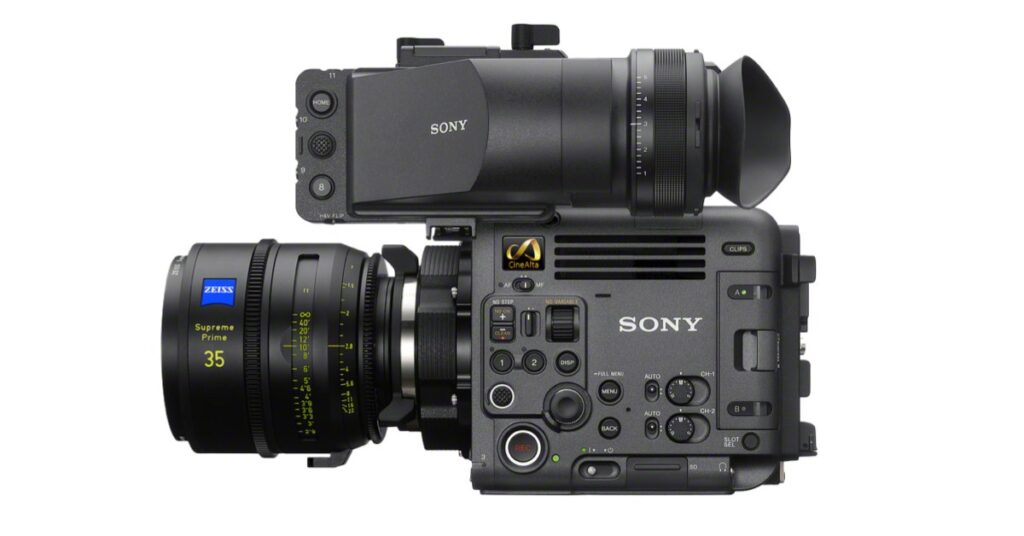
Sony has quietly added a new line to the official BURANO firmware roadmap: version 4.0. No press release, no fanfare — it simply appeared on the manufacturer’s page, dated “from May 2027 or later”. That’s a year and a half away. But what’s in it says a lot about where Sony is taking this body, and since we keep one on the rental shelf, we’d rather understand it now.
What’s in 4.0
Three lines, no more:
- support for X-OCN ST;
- control in a Multi Camera System (MCS) using the MSU and CNA-2;
- support for OpenTrackIO.
X-OCN ST: the last codec objection goes away
Today the BURANO only records X-OCN in the LT flavour, the lightest of the family, roughly 60% smaller than Sony RAW. ST is the middle tier, the one Sony recommends on VENICE for features, episodic and commercials, with files around 30% smaller than Sony RAW — so considerably heavier than LT.
In our view this isn’t about absolute image quality: LT holds up perfectly well on this camera for 90% of the jobs out there, and whoever says otherwise usually hasn’t graded much X-OCN LT. What it does is remove the last objection when the BURANO works as a B-cam next to a VENICE 2: same codec, same tier, nothing to explain in post. The trade-off is media and drives. A higher data rate means longer backups on set, and anyone who has already offloaded a full day in LT knows exactly what that feels like.
Multicam with MSU and CNA-2
For us this is the most concrete of the three. The CNA-2 is the network adaptor Sony uses to bring cameras into a multi-camera system driven by an MSU control panel — the same thing galleries have been using with system cameras forever. With 4.0 the BURANO joins that setup and gets handled from the panel along with the rest.
In Italy that means concerts, live events, theatre, talk shows, multicam streaming productions: work that today is done with system cameras and tomorrow could be done with full-frame cinema bodies, keeping the exact look the client saw in the single-camera promo. It’s the kind of news that gets no YouTube views and changes quotes.
OpenTrackIO
OpenTrackIO is the open protocol born inside the SMPTE RIS OSVP group (version 1 published in January 2025) to standardise camera and lens tracking data in virtual production. Having it natively means hooking a BURANO to an LED stage without proprietary bridges. There are no LED stages in Abruzzo, but a production coming down from Rome or Milan usually brings that workflow with it.
What it changes for anyone shooting today
Honestly, until 2027: nothing. And the date should be read for what it is. On the same page, 3.0 is listed as “from May 2026 or later”, and that “or later” carries weight. You don’t plan a job around a roadmap feature: you plan around what the camera does on the shoot day, not what it will do.
What does change is the buy-versus-rent maths. A body that keeps growing through firmware until 2027 is exactly the case where buying makes little sense if you shoot ten or fifteen days a year: you put thirty-odd thousand euro on the table today for a camera that will be a different camera in a year, and that has depreciated in the meantime. Renting, you take the version you need on the day you need it, already updated, and the money stays in the production.
The Sony BURANO is in our inventory. If you need a second body in the same colour ecosystem, the Sony FX6 and the Sony FX9 pair well with it; the rest is on our equipment page.
Official source: BURANO Firmware Roadmap — Sony. Verification: Newsshooter.
A wide range of equipment in our catalogue, on-set delivery included across Abruzzo.