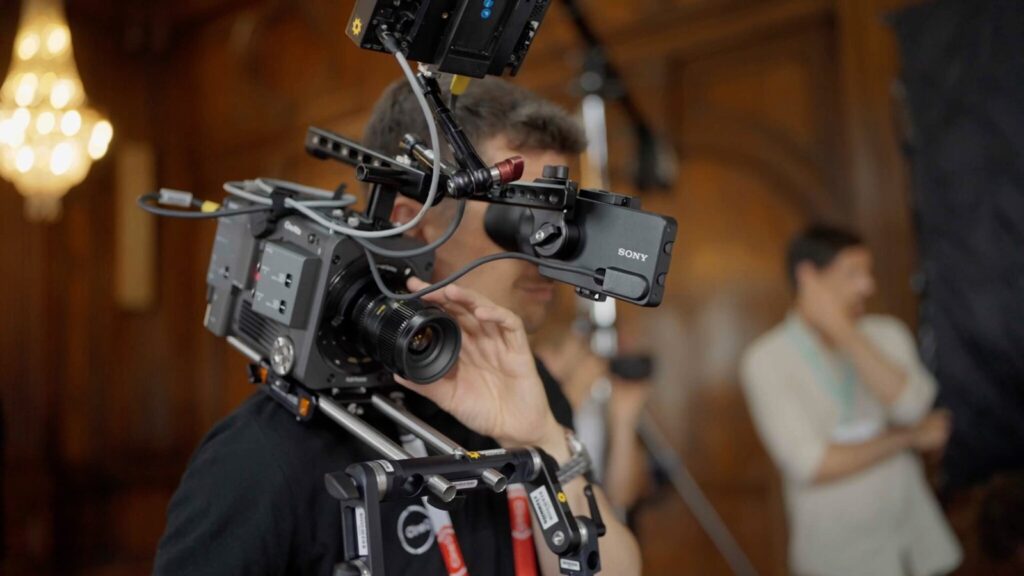
The Sony BURANO doesn’t need a long introduction. Hand it to an operator who has worked on a VENICE or an ALEXA and two minutes later the camera is configured and they are back to thinking about the frame. Since it joined our inventory it has become the A-cam we suggest most often when the client wants high-end images but the crew has to stay small.
What it brings to the table
- 8.6K full-frame sensor (8640×5760), dual base ISO 800/3200 and 16 stops of latitude claimed by Sony.
- Internal 16-bit X-OCN LT recording: real RAW, but with files you can still handle on a laptop while travelling.
- Built-in electronic variable ND up to 7 stops, driven by a dial on the body.
- In-body stabilisation: it is the first PL-mount cinema camera with IBIS.
- Frame rates: 8.6K full frame up to 30 fps, 6K cropped up to 60 fps, Super 35 4K up to 120 fps.
- Hybrid phase-detection autofocus with subject recognition when you mount E-mount glass.
- Dual CFexpress Type B slots.
Who it actually suits
In our opinion the BURANO has a very specific target: the production that wants a proper cinema-camera negative without hauling a truck and three extra people. Mid-budget commercials, light fiction, premium documentary, music videos. Internal ND, IBIS and autofocus together are what save you when there are two of you shooting in a hill town in Marsica, the light shifts every ten minutes and nobody is there to pull focus.
If you do have a full crew, a grip and a focus puller, and you are shooting on a dolly or a remote head, the advantage narrows: at that point choosing between the BURANO and the ARRI ALEXA Mini goes back to being a question of look and pipeline, not convenience.
Three things we always say at pick-up
Turn the IBIS off when the camera isn’t handheld. On a dolly, a slider or a gimbal it does more harm than good: small corrections you don’t notice on set and that drive you mad in the edit. Handheld with a 35mm or a 50mm, on the other hand, it’s gold.
Cards fill up fast. A 1.9 TB CFexpress Type B card gives you roughly two and a half hours in 8.6K X-OCN LT at 24 fps. That sounds like plenty, and it isn’t on a documentary day: budget for a second set of cards and half an hour of offloading at wrap, with a double copy.
Decide on the mount beforehand, not on set. The PL mount comes off and you can switch to E-mount, but it’s a job for a clean bench, not for the bonnet of a car. Tell us at quoting stage which lenses you plan to use and the camera arrives already configured.
What we pair it with
As a B-cam we almost always add a Sony FX3: same colour family, same profiles, they intercut without fighting in the grade. For director and client monitoring the Teradek Bolt 6 750 is our default, while for moves where IBIS isn’t enough the DJI RS 3 Pro carries the bare body with a compact lens without struggling. Ready-made combinations are on our kits page.
Why rent it instead of buying
The bare body costs as much as a mid-range new car, and that isn’t even the whole bill: cards, batteries, EVF, PL glass. For a production company shooting eight or ten days a year at this level the maths doesn’t work: at €280 a day, €700 for three days and €935 a week, the price of the body alone pays for several seasons of rentals — and every time you collect it the firmware is current and the camera has been checked.
If you have a project coming up and you aren’t sure the BURANO is the right call, write to us: quite often a different configuration makes more sense, and we would rather tell you upfront. Full specs and availability on the Sony BURANO page, the rest of the inventory is under equipment.
Official specifications on the Sony product page; for an independent technical breakdown, see the analysis by CineD.
A wide range of equipment in our catalogue, on-set delivery included across Abruzzo.