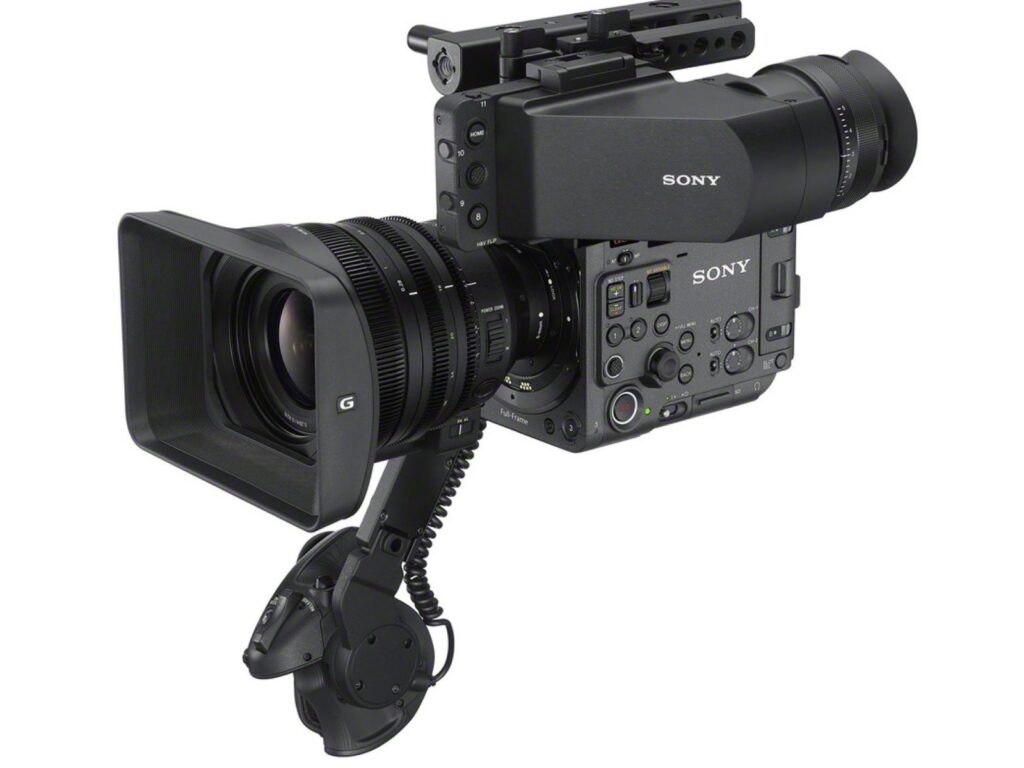
The Sony BURANO almost always leaves our shelves with the same brief: “we need a proper cinema camera, but there are only four of us.” That is exactly the job Sony designed it for, and in our view it is still the most sensible A-camera for small crews who don’t want to give up the VENICE look.
What’s inside, straight up
The sensor is the same format as the VENICE 2: full-frame 8.6K, roughly 41.9 effective megapixels, with the option to shoot Super 35 crop from the same body. From Sony’s official specs:
- 16 stops of stated latitude, dual base ISO 800 / 3200
- Electronic variable ND from 0.6 to 2.1, i.e. 7 stops, in steps or continuously
- 5-axis sensor-shift stabilization, even with the PL mount: it was the first PL cinema camera to offer it
- 627-point phase-detection autofocus with E-mount lenses
- Internal recording in 16-bit X-OCN LT or XAVC H and XAVC, on two CFexpress Type B slots
- Body weight of about 2.4 kg without the PL adapter
Who it’s for, in our experience
On set, the BURANO shines where a VENICE would be overkill and an FX6 a bit short. Commercials with two or three shoot days, light drama, documentaries headed for cinemas or streamers, music videos with a real production budget. The feature crews ask for most is being able to switch in ten minutes from sticks with PL primes to a shoulder rig with an autofocus E-mount zoom, without changing body or color science.
Where we don’t send it: on a lightweight gimbal. With lens, battery and transmitter the weight climbs fast, and for gimbal work we’d rather suggest a smaller body such as the Sony FX6 as B-cam, which shares Sony’s color family and cuts in without drama in post.
Why renting makes sense in Abruzzo
The BURANO launched in 2023 at 25,000 US dollars, body only. We rent it at 280 euros a day plus VAT, 700 for three days and 935 for a week. Paying off a purchase takes several dozen shoot days a year, and very few productions in Abruzzo and central Italy get there. The typical case we see is the opposite: a production shooting a big commercial or a short film once or twice a year that wants that quality only for those days. That’s where renting wins, not least because the camera leaves us already configured with media ready.
Three things that matter on set
- Stabilization isn’t always the same. With the PL mount you get Off, Low and High; Active mode with E-mount lenses only works in XAVC with the 5.8K imager mode, not in X-OCN and not in slow motion. Decide early whether the project is RAW or not.
- Power draw. Sony states about 50 W nominal in 6K X-OCN LT, climbing with proxies, Wi-Fi and accessories. We send it out on 190 Wh V-mounts and suggest planning one for every hour and a half to two hours of actual shooting.
- Pre-record saves shots. Cache recording holds 5, 10 or 20 seconds before you hit REC: on documentaries with moments that won’t happen twice, switch it on from day one.
What we pair it with
Even with a small crew the director still wants to see the image: the Teradek Bolt 6 750 is the natural choice, with one transmitter and two receivers. For two-camera work, the FX6 as B-cam. The full package, with lenses and batteries, is among our ready-made kits.
Full specs are on Sony’s official BURANO page, and Newsshooter’s BURANO 101 guide is a practical technical overview worth reading. If you’re choosing between BURANO, FX9 and FX6 for a specific project, ask us for a BURANO quote: we’ll tell you honestly whether it’s the right camera or whether you’re paying for quality the project won’t use.
A wide range of equipment in our catalogue, on-set delivery included across Abruzzo.