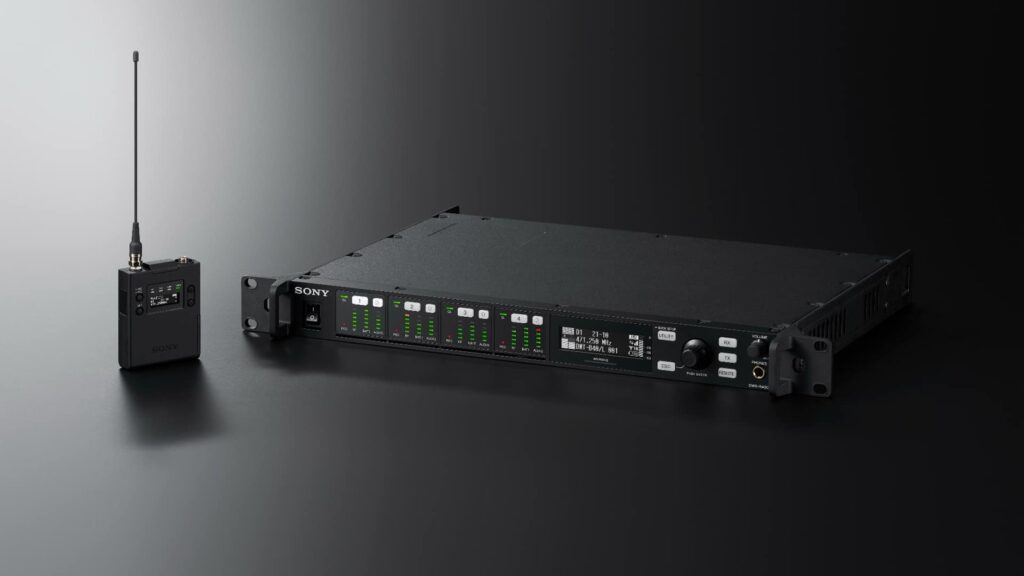
On September 9 Sony introduced the fourth generation of its DWX professional digital wireless series. Just two pieces: the DWT-B40 bodypack and the DWR-R40Q rack receiver. The receiver is not the real story, though. The story is that Sony put a 32-bit float recorder inside the transmitter.
What Sony announced
- DWT-B40: bodypack with internal 32-bit float recording to microSD cards up to 2 TB (roughly a thousand hours), Broadcast Wave files with onboard timecode, dual A/D converters, up to 50 mW of RF power depending on region, a condenser mic input with +48V phantom, and power from lithium-ion batteries or over USB.
- DWR-R40Q: a 1U receiver with four true-diversity channels, a four-antenna diversity mode, Dante across four output ports and the usual analogue XLR outputs.
- Quoted latency of 1.1 ms, with backward compatibility to DWX gear from 2012 onwards.
- Shipping in early 2027: February according to RedShark News, March in Sony’s US release. No pricing announced.
32-bit float in the transmitter is the news
Anyone who has pulled sound knows the problem with radio mics is rarely the sound quality. It’s the dropout. The sheet-metal warehouse, the hospital corridor, the fashion show with four hundred phones switched on. The link stutters for half a second and that line is gone.
The DWT-B40 keeps transmitting as always, but in parallel it writes a 32-bit float file to the card with its own timecode. That recorded file does not go over the air, there simply isn’t the bandwidth: it stays on the microSD and you pull it in post, synced by timecode. It is dual-system logic, packed inside the transmitter the talent is already wearing. One detail we like: Sony closes the file at regular intervals, so a dead battery doesn’t leave you with a corrupted recording.
A footnote most coverage glosses over: in the United States simultaneous recording and transmission is not available, because of Zaxcom’s patents. In Europe there’s no such limit, so here the feature works in full.
On set, in Italy
Let’s be honest: a four-channel Dante rack is not built for the three-person short film. Sony talks about theatres, opera houses, musicals and studios, and the product shows it. For a commercial or a documentary in Abruzzo we’ll keep working dual system with lavs and a recorder, and that’s fine.
Where it does move the needle is the work we get asked for more and more: conferences, talks, live streams, corporate events. There, 1.1 ms of latency and four-antenna diversity genuinely matter, because the spectrum is a mess. If you already have a Teradek Bolt 6 750 pushing video to the monitors, plus intercom, plus the venue Wi-Fi, you take every scrap of RF stability on offer. In our view that’s exactly why Sony leaned on the radio side before the audio side.
The other serious change is simpler pairing. Setting frequencies and pairings on digital systems has always been a trade of its own: if four channels can now be configured in a few steps, that rig can land in the hands of people who aren’t sound mixers by profession. In practice that means fewer half-hours burned before the first take.
Buy or wait
Nothing ships before March 2027, and there are no prices. CineD, which gathered the details at IBC, reports a list roughly 30% below the previous generation: that would be good news, but until Sony puts it in writing we treat it as an indication, not a price.
The rental logic hasn’t changed. A professional wireless system only pays for itself if you use it dozens of days a year; if you need it for three events a season, that money sits better in a lens or in one more day of crew. In the meantime, for anyone shooting sync sound, the bodies we hand out most often are still the Sony FX9 with its XLR handle and the Sony FX6: two proper XLR inputs, onboard timecode and no excuse for bad tracks. The rest of the fleet is in equipment.
Official source: Sony Electronics press release, September 9, 2026.
A wide range of equipment in our catalogue, on-set delivery included across Abruzzo.