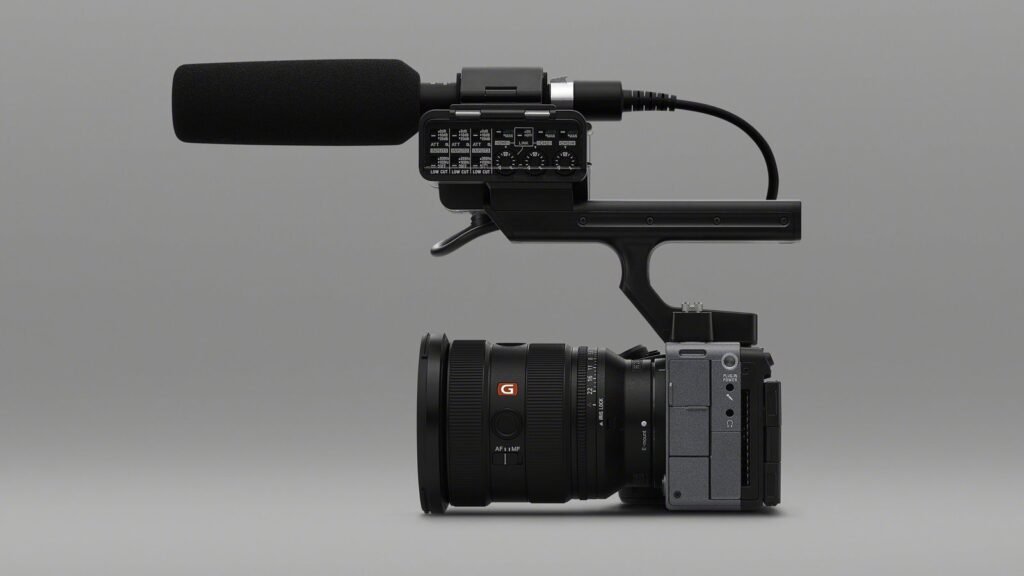
Sony announced the FX5 today, 22 July. It slots between the FX3 and the FX6 in the Cinema Line, but the real story isn’t the positioning: it records X-OCN internally in a body that costs $4,898. Until yesterday that codec meant VENICE or BURANO, which is a different budget bracket and a different kind of production entirely.
What’s inside
A 16.6-megapixel full-frame stacked Exmor RS sensor, a BIONZ XR2 processor with a dedicated AI unit, and a claimed 15+ stops of latitude in S-Log3. The rest of the official spec sheet:
- Triple base ISO: 800, 4000 and 12800 — a first for a Sony body under $6,000
- 5K up to 60p, 4K up to 120p, FHD up to 240p, with a 3:2 Open Gate mode
- Internal 16-bit X-OCN in LT, C1 and C2, plus XAVC S-I, XAVC HS and XAVC S
- Dual CFexpress Type A slots (X-OCN requires VPG400-certified cards)
- 5-axis optical stabilisation, anamorphic desqueeze from 1.3x to 2.0x
- Audio up to 96 kHz / 32-bit float across 4 channels with the XLR handle
- Optional 0.58″ tilting OLED viewfinder, body weight around 730 grams
The body alone is $4,898, or $5,498 in the kit with the XLR handle. European pricing hasn’t been announced yet. One detail worth flagging: the FX5 has no stills functionality at all — it’s a video camera, full stop.
Why internal X-OCN changes the maths
This, to us, is the point of the camera. X-OCN is 16-bit scene-linear RAW, but the files are far more manageable than ProRes RAW or REDCODE at comparable quality: in LT you stay under 100 MB/s across plenty of resolution and frame-rate combinations. For a mid-budget Italian production that means shooting RAW on a commercial or a short film without tripling the storage budget and without carrying an external recorder.
The same workflow on a Sony BURANO costs considerably more per day. The FX5 brings it to a body you can hold in one hand, put on a gimbal, and run without a structured camera department.
Two things to plan for
First, the data. Internal X-OCN means VPG400 CFexpress Type A cards — not the cheap ones — and a serious backup plan on set. Shooting two days in LT without a data wrangler and two copies is a risk that isn’t worth the saving. Second, the class of camera: 5K60 and 4K120 are strong numbers, but anyone who needs internal NDs, SDI out and a body built to sit on a shoulder for eight hours is still better served by the FX6. It’s not the same camera; it’s a different set logic.
When renting beats buying
Five thousand dollars plus lenses, cards, batteries and rigging comfortably clears €9,000 of investment. If you shoot two or three projects a year that genuinely call for RAW, that capital never comes back: it only amortises at a volume of work very few people have in Abruzzo. And if you already run an FX3 as your A-cam, there’s another reason to wait — the jump is real, but it isn’t urgent.
Our advice is the same as always: rent it for the project that justifies it, put it on the quote as a line item, and pass it through to the client. Sony availability on Cinema Line launches is historically slow in the first months, so we’ll update our catalogue as soon as Italian dates land. In the meantime, we still think the FX5 is the most interesting camera announced this year for anyone working with mid-range budgets.
Official source: Sony Cinematography. Technical breakdown on Newsshooter.
A wide range of equipment in our catalogue, on-set delivery included across Abruzzo.