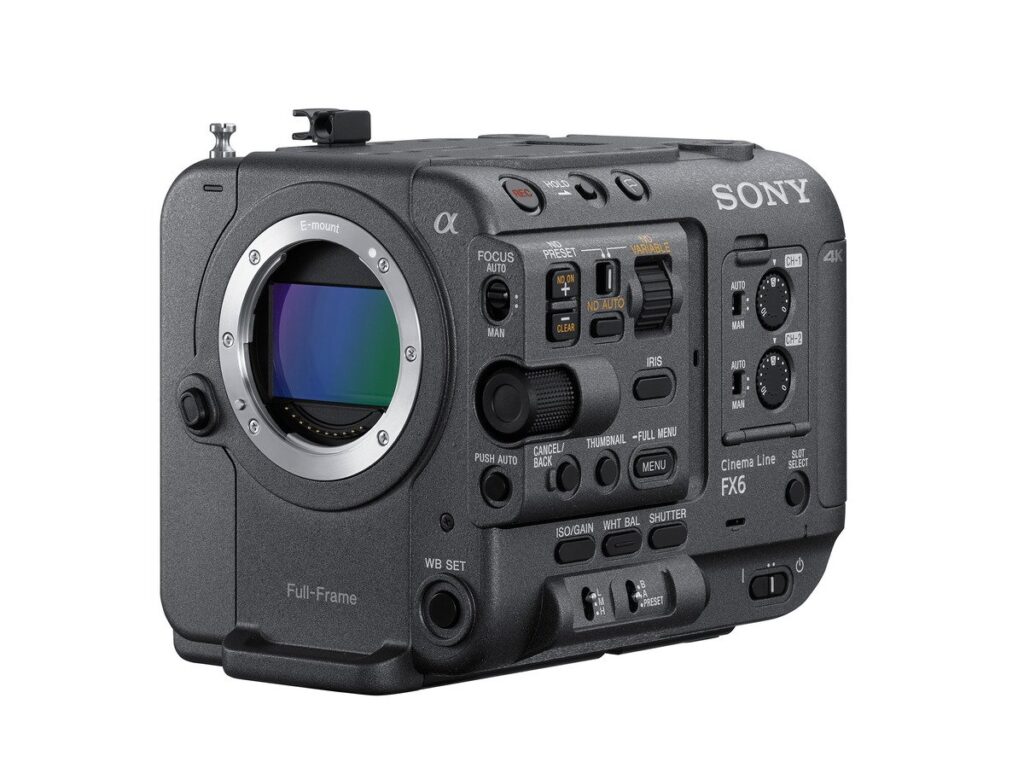
The Sony FX6 is the body that leaves and returns to our warehouse more than any other. Which is exactly why we keep seeing the same five stumbles, almost always from good operators who simply hadn’t shot on an FX6 before. None of them is a flaw in the camera: they’re decisions made the day before, at booking time, and they can’t be fixed on set.
1. Settling for the small battery
The FX6 runs on BP-U batteries. The BP-U35 is the common one, it’s compact and pockets easily, but with the monitor on and autofocus working it won’t cover a full day. If the call sheet says ten hours, ask for BP-U70 or BP-U100 packs: they add weight at the back but they remove the battery swap in the middle of a take. The alternative is going V-mount with a plate, and then the problem disappears altogether.
2. Assuming SD cards will do
The dual slot takes both CFexpress Type A and SDXC, and that flexibility is misleading. SD cards are fine for Long-GOP and for 4K at 25 or 50p, but once you move to XAVC-I, and especially when you reach for 120 fps in 4K, the right card is CFexpress Type A. Turn up with two V90 cards in your pocket thinking you’re covered and you’ll find the recording stopping at the worst possible moment: on the slow-motion take that can’t be repeated.
3. Leaving the ND on auto all day
The built-in electronic variable ND is why this camera wins at run-and-gun: you go from a sunlit church forecourt into a dim reception hall without screwing anything on. Auto mode, though, works continuously, and on a locked-off shot with a cloud passing you can see the exposure breathing. Our rule on set: auto while you’re walking and following, manual the moment the camera settles on sticks.
4. Updating the firmware the night before
On the FX6, updating the firmware wipes your settings: button assignments, picture profiles, everything you built. On top of that, version 6.00 changed the interface and September’s 6.01 adjusted colour rendering in highly saturated areas, so two bodies on different firmware won’t give you exactly the same red on the same set. In the warehouse we apply a blunt rule: firmware gets touched before the project, never during it. If you need two bodies, they arrive on the same version.
5. Expecting RAW from the wrong recorder
The FX6 sends its 16-bit RAW out of the BNC, and that needs a recorder with an SDI input. The Atomos Ninja V we rent works over HDMI: as a monitor and as a ProRes recorder it’s perfect, but it won’t take the FX6’s RAW. If the project calls for it, say so when you book and we’ll send the right chain, rather than letting you discover it with the camera already in your hands.
Buying one makes less sense than it did a year ago
One figure makes this concrete: from 1 September Sony adjusted its Italian price list and the FX6 went up by roughly 11.8%. Anyone shooting a handful of projects a year now faces an even longer payback, while the same body on rental arrives serviced, with the cards and batteries that specific job needs, and delivery to set included across the region.
We know which combinations work: the Sony FX3 as a B-cam, because colour and workflow stay the same, and the DJI RS 3 Pro for movement, balanced before it leaves us. The rest is in our kits.
Official specifications are on the Sony ILME-FX6 page; the technical breakdown from launch, with the sensor and Dual Base ISO numbers, is on CineD.
A wide range of equipment in our catalogue, on-set delivery included across Abruzzo.